Load Balancing Conditions
Conditions used by the Broker and by Load balancing Flows require VisualCron 11.2.1 or later and a Pro Subscription license. Conditions used by Server Health and the Variable Trigger follow the license requirements of those features.
Load balancing Conditions can be used in several different VisualCron components:
- Load balancing Broker (Scheduler switch condition; Server Agents filter)
- Load balancing Flows
- Server Health (user changes are not supported)
- Variable Trigger
Editing Load balancing Conditions
All Load balancing Conditions are created and edited using a single form consisting of two tabs.
On the first tab, the basic properties are configured: condition type and description.

On the second tab, properties specific to the chosen condition type are edited.
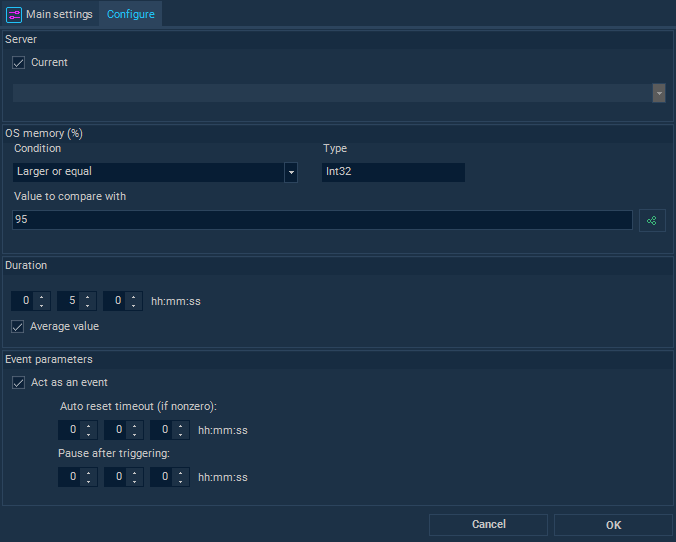
Depending on the condition type, the following property groups can be edited:
- Server selector
- Job selector
- Connection selector
- Network selector
- Time exception selector
- Variable selector
- File selector
- Process selector
- Windows service selector
- Operand and value to compare with
- Duration, including average checkbox
- Act as an event (for state-check conditions)
- Event parameters (for event-based conditions)
Condition classification
All Conditions fall into two groups: conditions that check some state, and conditions that react to some event in the system.
- State-check Condition example: the value of the Variable TestNumber is
42. - Event-based Condition example: the value of the Variable TestNumber has been updated.
- State-check Condition acting as an event: the value of the Variable TestNumber has been updated and became equal to
42.
Configuring parameters of an event-based Condition

Pause after triggering
The period after a previous trigger when event generation is suppressed. If an event occurs before the suppression period ends, the event is ignored (the behavior is different for state-check conditions — see below).
Force event reset after each condition set calculation (the default)
The state is set to nonsignaled when the entire condition tree is calculated, regardless of whether the event is checked directly or not.
Keep signaled state until event is checked directly
The event remains in the signaled state until it is checked directly during condition calculations.
Configuring parameters of a state-check Condition acting as an event

Act as an event
The next match of the state-check condition is possible only after an unmatched state is detected or the reset timeout expires.
Auto reset timeout
If non-zero, the condition can trigger again after the specified timeout even if the state has matched the whole time. Takes precedence over the Pause after triggering period, so it can shorten the suppression period.
Pause after triggering
The period after a previous trigger when event generation is suppressed. If, while waiting for the suppression period to end, the state changes to non-matching and then back to matching, the condition triggers again immediately after the suppression period ends.
Examples
Move the Scheduler role off a Server that is struggling
Used as a Broker Scheduler switch condition:
- Condition type: Health status
- Value: Very bad
- Duration:
5minutes
Adding a duration prevents a momentary spike from moving the Scheduler role.
Do not send Jobs to a Server that is already busy
Used as a Broker agent filter condition:
- Condition type: Total running Jobs
- Operand and value: over
0
Act on sustained CPU load
Used in a Load balancing Flow:
- Condition type: OS CPU (%)
- Operand and value: over
90 - Duration:
5minutes, with Check average enabled
The list of supported Load balancing Conditions
Abbreviations:
- Flows - Load balancing Flows
- Broker - Load balancing Broker
- Health - Server Health
- N/A - not yet available
Server statistics counters
| Description | Display name | Supported modes | Additional features | Used in components |
|---|---|---|---|---|
| VC Server CPU (%) | VCServerCPUStatus | state / event | duration, average | Flows, Broker, Health |
| OS CPU (%) | OSCPUStatus | state / event | duration, average | Flows, Broker, Health |
| VC Server memory (%) | ServerRAMStatus | state / event | duration, average | Flows, Broker, Health |
| OS memory (%) | OSRAMStatus | state / event | duration, average | Flows, Broker, Health |
| Used VC Server Drive space (%) | DiskSpaceStatus | state / event | duration | Flows, Broker, Health |
| Daily Server uptime (%) | ServerUptimeStatus | state / event | Flows, Broker | |
| Maximum [last minute] response time (ms) | MaxResponseTime | state / event | duration | Flows, Broker |
| Total running Jobs | TotalRunningJobs | state / event | duration, average | Flows, Broker |
Job statistics and states
| Description | Display name | Supported modes | Additional features | Used in components |
|---|---|---|---|---|
| Total # running same Jobs | TotalRunningSameJobs | state / event | duration, average | Flows |
| Job is running | JobIsRunning | state | Flows | |
| Job runtime | JobRunningTime | state / event | duration, average | Flows |
| Job status | JobStatus | state / event | N/A |
Log database
| Description | Display name | Supported modes | Additional features | Used in components |
|---|---|---|---|---|
| LogDB size (kB) | LogDBSize | state / event | Flows | |
| LogDB fragmentation (%) | LogDBFragmentation | state / event | Flows |
Time Exceptions
| Description | Display name | Supported modes | Additional features | Used in components |
|---|---|---|---|---|
| Time Exception collection matches | TimeExceptionMatches | state | Flows | |
| Time Exception occurred | TimeExceptionEnter | event | N/A |
Broker connections
| Description | Display name | Supported modes | Additional features | Used in components |
|---|---|---|---|---|
| VC Server is connected | VCServerIsConnected | state | Flows | |
| VC Server connected | VCServerConnected | event | Flows | |
| VC Server disconnected | VCServerDisconnected | event | Flows | |
| VC Server is responding | VCServerIsResponding | state | N/A |
Connections API
| Description | Display name | Supported modes | Additional features | Used in components |
|---|---|---|---|---|
| Connection is active | ConnectionIsActive | state | N/A | |
| Number of Connection instances | ConnectionInstances | state | N/A |
Networks API
| Description | Display name | Supported modes | Additional features | Used in components |
|---|---|---|---|---|
| Network is connected | NetworkIsConnected | state | Flows | |
| Network connected | NetworkConnected | event | Flows | |
| Network disconnected | NetworkDisconnected | event | Flows |
Health API
| Description | Display name | Supported modes | Additional features | Used in components |
|---|---|---|---|---|
| Health status | HealthStatus | state / event | duration | Flows, Broker |
Variables
| Description | Display name | Supported modes | Additional features | Used in components |
|---|---|---|---|---|
| Variable value | VariableValue | state / event | duration, average (for numerics) | Flows, Variable Trigger |
| Variable value changed | VariableValueChanged | event | Flows, Variable Trigger |
External processes
| Description | Display name | Supported modes | Additional features | Used in components |
|---|---|---|---|---|
| File status | FileStatus | state / event | duration | N/A |
| Process status | ProcessStatus | state / event | duration | N/A |
| Process CPU (%) | ProcessCPUStatus | state / event | duration, average | N/A |
| Process terminated | ProcessTerminated | event | N/A | |
| Windows Service status | WinServiceStatus | state / event | duration | N/A |
Degenerate cases
| Description | Display name | Supported modes | Additional features | Used in components |
|---|---|---|---|---|
| Default (success) | Any | Flows, Broker | ||
| Default (failure) | None | Flows |