Global - Time Exceptions
A time exception is a period when a Job must not be started by its Triggers, for example a public holiday. Time exceptions are grouped in collections. For example, a collection named "USA - holidays" can hold one exception for each US public holiday. A Job that runs every day and uses that collection skips those days.
This page covers the Time exceptions window, collections, exceptions, and how to import, export and download collections. To choose the collections a Job uses, see Job - Time Exceptions.
To open the window, click Server -> Global objects -> Time exceptions. You can also add and edit collections and exceptions on the Time exceptions tab of the Job window.
How a time exception works
- When a Time Trigger fires inside an exception, the Job does not run. The run is skipped, not postponed. The same applies to an Event Trigger that reacts to an event as it happens, for example a File Trigger that watches a folder
- An Event Trigger that polls does not poll during an exception. Examples are the Remote File, Cloud File, SQL, Mail and RSS Triggers, and a File Trigger with Use polling (Samba compatible) checked. When the exception ends, the next poll still finds the files, rows or messages that arrived during the exception, and the Job can run for them then
- When the Server runs missed Jobs, it skips a missed run that falls inside an exception
- Runs started manually, by a Run Job action in a Flow, by a Job/Task control Task, or by Trigger on existing files on a File, Cloud File or SharePoint File Trigger are not blocked. A Job started by a VisualCron Event Trigger on another Job's event, for example when that Job completes, is a Trigger run and is blocked
- Each check that falls inside an exception raises the VisualCron event Job missed: each skipped Time Trigger or Event Trigger run, each poll that a polling Trigger skips, each missed run that the Server skips, and each Trigger on existing files run, although that run is not blocked. A Job with a VisualCron Event Trigger on Job missed runs each time, so it can run many times during one exception
- When Extended Job debug logging is checked on the Job, the Server logs each skipped run with the names of the exception and the collection, see Job - Main Settings. A missed run that the Server skips is always logged, without those names
- The Job's Next run does not skip excepted times. It shows the next Trigger time even if that time is inside an exception. After a run is skipped, VisualCron calculates the next one
- If a collection that a Job uses is deleted, it no longer blocks that Job, and the Server logs an error each time it checks that Job. Before you delete a collection, use Object relations to find the Jobs that use it, and remove it from their Time exceptions tab
Do not add the collections of the Jobs you watch to a Job that runs on Job missed, and check Ignore current Job on its VisualCron Event Trigger. If that Job is blocked by the same exception and its Trigger reacts to its own Job missed events, the events can repeat without end.
A change to a collection changes every Job that uses it. Before you edit or delete a collection, right-click it and click Object relations to see which Jobs use it.
Time exceptions window
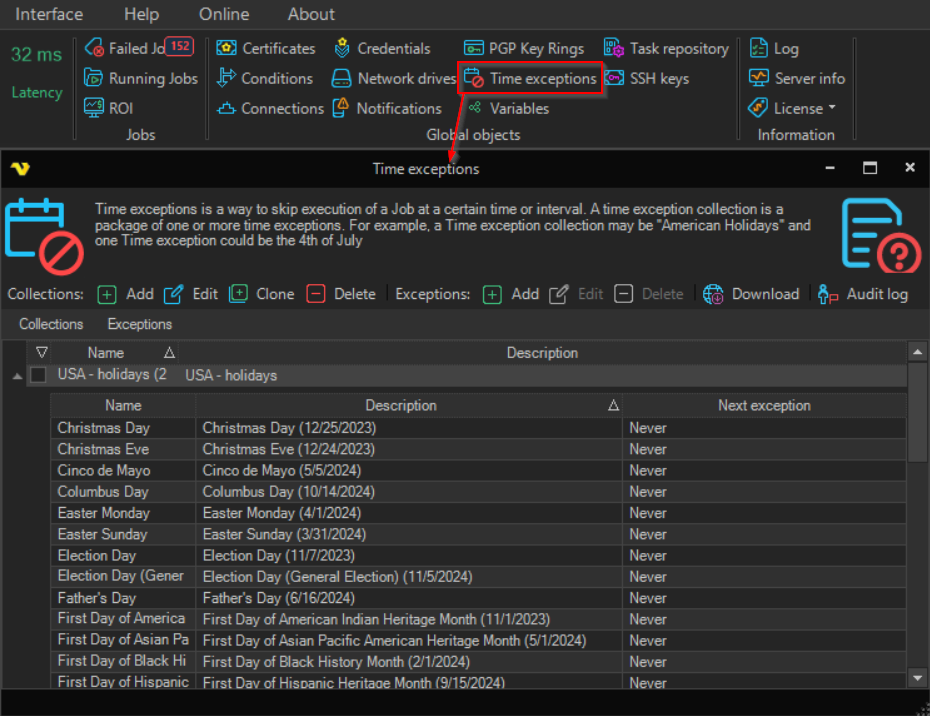
The grid lists the collections with a checkbox, Name and Description. Expand a collection to see its exceptions with Name, Description and Next exception. Next exception is the next time the exception is in effect, or "Never" if it will not be in effect again. It is updated every minute.
The checkbox beside a collection selects it. In this window it only marks the collections for Collections -> Export selected: checking a collection here does not make any Job use it. On a Job's Time exceptions tab, the checkbox sets which collections the Job uses, and checked collections are listed first.
The toolbar has two groups and two more commands:
- Collections: Add, Edit, Clone and Delete
- Exceptions: Add, Edit and Delete. Select an exception to edit or delete it
- Download: download holiday collections published by VisualCron, see Download collections
- Audit log: open the Audit log for time exceptions
The menu bar has the same Collections and Exceptions commands, but not Download or Audit log. It also has:
- Collections -> Select all and Deselect all: check or clear every collection
- Collections -> Import: import collections from a file, see Import collections
- Collections -> Export selected: save the checked collections to an XML file, see Export collections
The menu bar is only in this window, not on a Job's Time exceptions tab.
Right-click a row for these commands:
- Add collection, Edit collection, Clone collection and Delete collection
- Add exception, Edit exception and Delete exception
- Audit log: the Audit log for all time exceptions
- Versions: the version history of the collection
- Object relations: the Jobs that use the collection, see Object relations
- Export ...: export the collection with Export settings
- Send to connection ... and Send to server connection ...: send a copy of the collection to another VisualCron Server
Versions and Object relations always apply to the collection, even when an exception is selected.
Double-click a row to edit it. Press Delete to delete the selected collection or exception.
Add or edit a collection
The Add/Edit collection window has Name and Description. After you add a collection, select it and add its exceptions.
When you edit a collection, the window shows the link Copy Time Exception collection id. Click it to copy the collection's Id to the clipboard. Right-click it to change the Id: enter the new Id, which must be a GUID. If another collection already uses that Id, VisualCron asks for a different value. VisualCron shows how many objects refer to the collection. Click Yes to change the Id and update the Jobs that use it, No to see the list of objects first, or Cancel. The new Id is saved on the Server as soon as you click Yes; clicking Cancel in the Add/Edit collection window does not undo it. Scripts or API calls that use the old Id are not updated.
After you change the Id of a collection, the Jobs that use it can stop being blocked by it until the VisualCron service restarts, and the Server logs an error each time it checks those Jobs. Do not change the Id of a collection that Jobs use.
Clone or delete a collection
Clone opens the Add/Edit collection window for a copy of the collection. The window shows only Name and Description, but the copy also gets all the exceptions of the original. The copy and its exceptions get new Ids and are saved when you click OK. The copy has the same name as the original, so change the name to tell them apart. Jobs that use the original keep using the original.
When you delete a collection that Jobs use, VisualCron tells you how many objects use it.
Add or edit a time exception
Select a collection and click Add in the Exceptions: group. The Time exception window has a Main settings tab with Name and Description, and six time tabs:
- Year: Every year, Choose year(s) or Between years. The lists cover the current year and the next 19 years
- Month: Every month, Choose month(s) or Between months
- Day: Every day, Choose day(s), Between days, Choose weekday(s) or Between weekday(s)
- Hour: Every hour, Choose hour(s) or Between hours
- Minutes: Every minute, Choose minute(s) or Between minutes
- Second: Every second, Choose second(s) or Between seconds
The exception is in effect at every moment that matches all six time tabs, Year to Second. The status bar shows Next exception and updates it while you change the settings.
For example, to skip runs all day on 4 July every year: on Year, select Every year. On Month, select Choose month(s) and check July. On Day, select Choose day(s) and check 4. Leave Hour, Minutes and Second at Every.
A new exception starts with Every on every tab, and a Choose option with nothing checked also counts as Every. An exception that you save without narrowing any tab blocks every Job that uses the collection at all times. Check that Next exception in the status bar shows the date you expect before you click Ok.
An exception whose chosen years (Choose year(s)) have all passed shows "Never" and blocks nothing. Those years are not in the year list, so if you open the exception and click Ok, it applies to every year. Click Cancel to leave it unchanged, or choose the years it should apply to before you click Ok. To retire an exception, delete it.
Import collections
Click Collections -> Import in the Time exceptions window and choose an XML or CSV file.
The XML file must be one saved with Collections -> Export selected, on this or another Server. Collections are matched by Id: a collection with the same name but a different Id is added as a second collection. If a collection in the file is already on the Server, VisualCron asks what to do:
- Replace: replace the collection with the one in the file. Exceptions that are not in the file are removed
- Skip: keep the collection on the Server
- Replace all: replace this and every following collection without asking
The question does not show which collection it is about. To decide per collection, import files that hold one collection each.
A CSV file has one line per exception, with five fields separated by commas: collection name, collection description, exception name, exception description and date:
<collection name>,<collection description>,<exception name>,<exception description>,<yyyy-MM-dd>
For example: USA - holidays,US federal holidays,Independence Day 2027,,2027-07-04
Each line adds an exception for that date only, for the whole day. Collections and exceptions are matched by name, including upper and lower case: a new name adds a collection or an exception, and an existing collection is updated without asking. For an existing collection, the collection description in the file is ignored. A field can be empty, but names and descriptions cannot contain commas. Do not add a header line: a line whose date cannot be read stops the import, and nothing is imported. VisualCron shows no message when the import succeeds; the collections appear in the window.
If a line names an exception that already exists, VisualCron changes that exception: it adds the month and day to the ones already chosen, replaces its first chosen year with the year of the line, and sets hours, minutes and seconds to every. The exception can then match other days than you expect. For example, an exception "Holiday" for 2027-12-25 that receives the line ...,Holiday,,2027-07-04 then matches 4 and 25 July and 4 and 25 December 2027. Give each date its own exception name, for example with the year in it.
Export collections
To move collections to another Server, check them and click Collections -> Export selected. VisualCron saves them to an XML file, by default named timeexceptions<yyyyMMdd>.xml. On the other Server, import the file with Collections -> Import. You can also right-click a collection and click Send to connection ... or Send to server connection ... to send a copy directly.
The shortcut-menu Export ... uses Export settings. Import that file with Import settings, not with Collections -> Import.
Download collections
VisualCron publishes holiday collections for a number of countries. To add one:
- In the Time exceptions window, click Download. The Time exceptions - download window lists the published collections with a flag, the name and the date of the last update.
- Check Import for each collection you want.
- Click Import. The window closes and the collections appear in the Time exceptions window.
To fetch the list again, click Reload. The Client fetches the list from the VisualCron website, so the computer that runs the Client needs internet access.
If a downloaded collection is already on the Server, for example because you downloaded it before, Import replaces it without asking. Exceptions you added to it are removed. Jobs that use the collection keep using it.
Keep your own exceptions in a separate collection and let the Job use both.
After a download, check Next exception for each exception. Exceptions for dates that have passed show "Never" and block nothing. If every exception of a collection shows "Never", check Last Update in the download window: if the published collection has a newer update, download it again (this replaces it, see the warning). Otherwise add the dates you need as new exceptions in your own collection. Do not open and save an expired exception, see Add or edit a time exception.
For reference, the US Office of Personnel Management publishes the US federal holidays.
Where the settings are stored
The Server stores all collections in the file "timeexceptions.xml" in its settings folder. By default this is the "settings" folder under the installation folder, "C:\Program Files (x86)\VisualCron\settings" on 64-bit Windows. You can change the folder under Settings folder on the Folders tab of the Server settings, see Settings - Folders.