Global - Notifications
Notifications are since version 7.0.0 a way to create global, independent Tasks. The Notifications are stored centrally and are called from Job Flow or Task Flow. Any Task can be used as a Notification. The purpose of Notifications was originally to create, e.g. an Email Task once and then be able to re-use it in Job and Task Flow whenever you wanted to receive a Job or Task email with output or similar.
A notification is defined either from the main menu Server > Global objects > Notifications dialog or from the Job Flow or Task Flow.
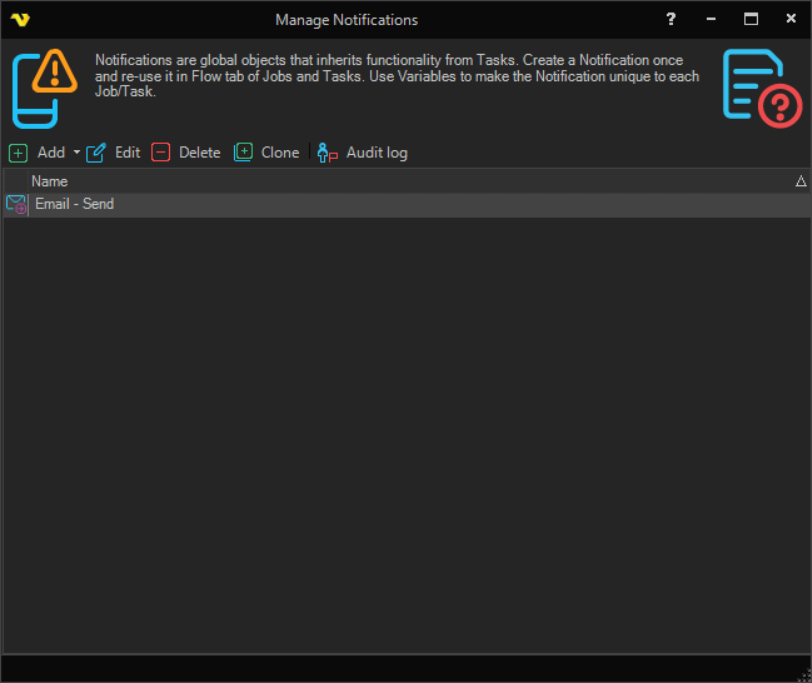
The Manage Notifications window shows configured notifications in a grid. Each row displays the notification type icon and the Description of the notification.
The toolbar above the grid provides the following buttons:
- Add — opens the Add notification dialog so you can pick a notification (Task) type to create
- Edit — edit the selected notification
- Clone — create a copy of the selected notification
- Delete — delete the selected notification
- Audit log — open the Audit log for notifications
Right‑clicking a notification opens a context menu that includes the toolbar commands plus the following additional options:
- Versions — view the version history for the notification
- Object relations — view other VisualCron objects (Jobs, Tasks, Triggers) that reference this notification
- Notification log — open the Notification Log filtered for this notification
- Export — export the selected notification
Add / Edit notification
The Add/Edit Notification dialog contains the following shared controls at the top:
- Notification type — a dropdown that selects which kind of Task is used as the notification (Email, File, Event Log, Syslog, Popup, Sound, Database, Message, etc.). Switching the type changes the configuration tab below
- Description — a free‑text name shown in the notification list and used to reference the notification from Job/Task Flow
- Execute credentials — the Credential used to execute the notification. Click the manage button next to it to open Manage Credentials
- Notification Id link (visible when editing only) — left‑click to copy the internal notification ID to the clipboard; right‑click to change the ID
The tab below the shared controls displays the configuration specific to the selected notification type. For specific instructions for each notification type, see the help page for the relevant Task.
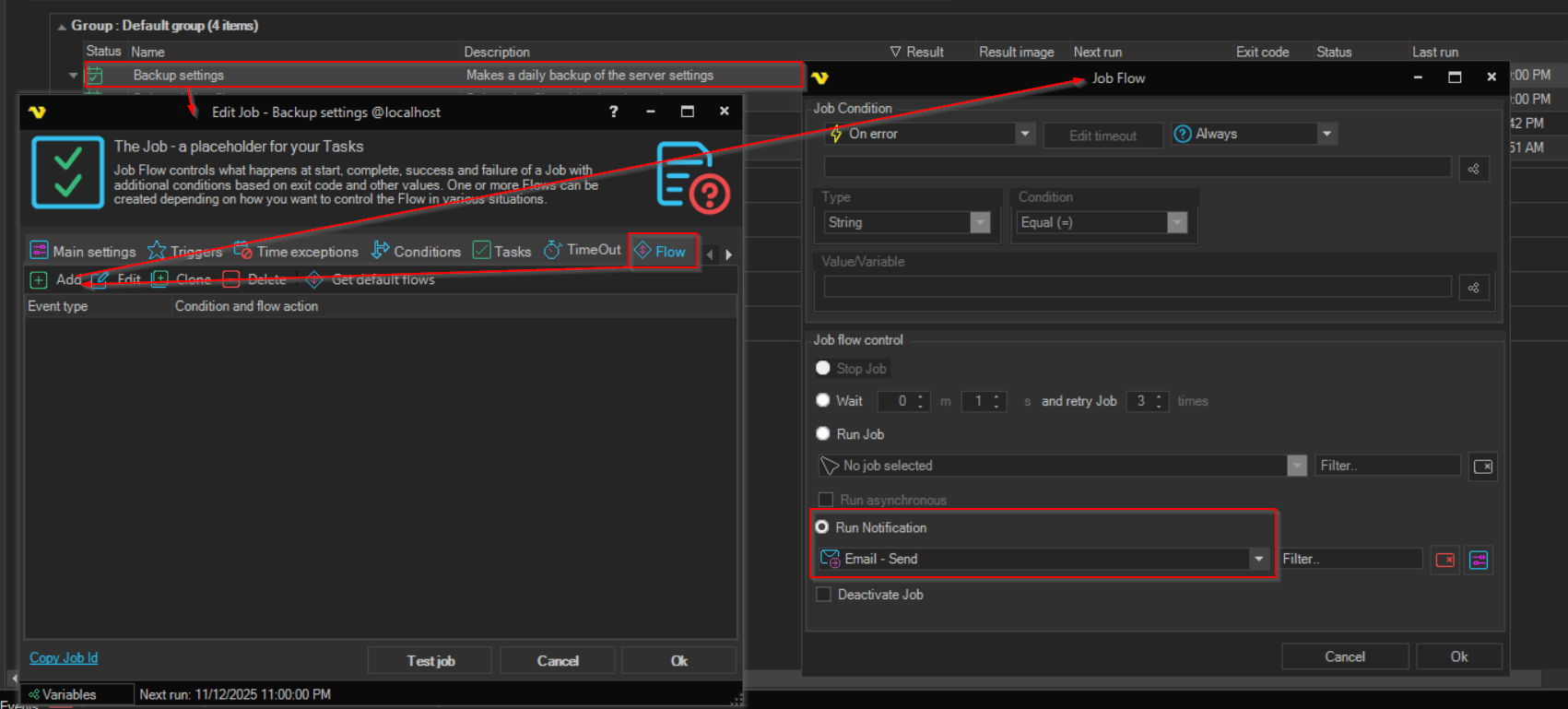
Below is a screenshot from Task Flow of a Task which, On error, also sends a Notification 'test'.
If cloning a notification, object relations are not cloned.
Variables
As usual you can use any Variable in any field within VisualCron.
View additional variable information.
All variables are not available at all times. The variables are highly dependant on when you choose to notify. For example, specific Task variables are only available when you choose to Notify on start or Notify on complete. Also, if you choose to the variable Output you will get the output of the previous run when using when a Task has completed. The current output is not available until "when a Task has completed".
Notification Log
The Notification Log shows when each notification was fired, what event triggered it, and the resulting output. Use it to audit notifications and to verify that they ran as expected.
Filter bar
At the top of the log, the filter bar provides the following controls:
- Notification — a checkbox dropdown of all configured notifications. Tick one or more notifications to limit the log to just those entries
- Text filter — free‑text search across the visible rows
- Clear filter — remove the text filter
- From / To date pickers — limit the log entries to the chosen date range (defaults to today)
- Get — fetch log entries from the server using the current filter settings
- Filter… — open the advanced filter dialog for additional criteria
Log grid
The log grid shows the following columns:
- Task type — icon indicating the notification's underlying Task type
- Notification name — the description of the notification that fired
- Event date/time — when the notification was fired
- Exit code — the exit code returned by the notification Task
- Execution time — how long the notification took to execute
- Standard output — the captured standard output from the notification
- Standard error — the captured standard error from the notification
- Event type — icon + text describing which event triggered the notification (for example Start, Complete, Error)
- Job name — the Job that triggered the notification (hidden when filtering by a specific notification)
- Task name — the Task that triggered the notification (hidden when filtering by a specific notification)
- Result — icon indicating the overall outcome (success, failure, pending)
Log entries are sorted in descending order by event date/time so the most recent entries appear first.