Main - Settings
The Server settings window holds the settings that apply to the whole Server. Open it from the main menu Server -> Main settings -> Settings. You need the "Server settings" permission with "Read" to open the window, and with "Edit" to save changes with Apply settings (see Main - User Permissions).
The window has these tabs:
- Main settings: described on this page
- Default flows: see Settings - Default Flows
- Users/Logon: see Settings - Users/Logon
- Log settings: see Settings - Log Settings
- Email settings: see Settings - Email Settings
- Proxy: see Settings - Proxy
- Folders: see Settings - Folders
- Web API: see Settings - Web API
- Web Client: see Settings - Web Client
- Password rules: see Settings - Password Rules
Most changes take effect on the Server when you click Apply settings. Cancel closes the window without saving them.
These buttons act on the Server at once, without Apply settings, and Cancel does not undo them:
- The firewall button next to Server port and the UAC button, on the Main settings tab
- Add to all existing and Delete from all existing, on the Default flows tab
- Create DB tables, Clear all, Recreate table and Rebuild indexes, on the Log settings tab
The buttons on the Web Client tab also act at once, on the computer where the Client runs.
The buttons in the list above do not check the "Edit" permission. Any user who can open this window can use them, for example to delete log data or to remove the firewall rule. Give the "Server settings" permission only to users you trust with these actions.
Server -> Main settings -> Settings -> Main settings tab
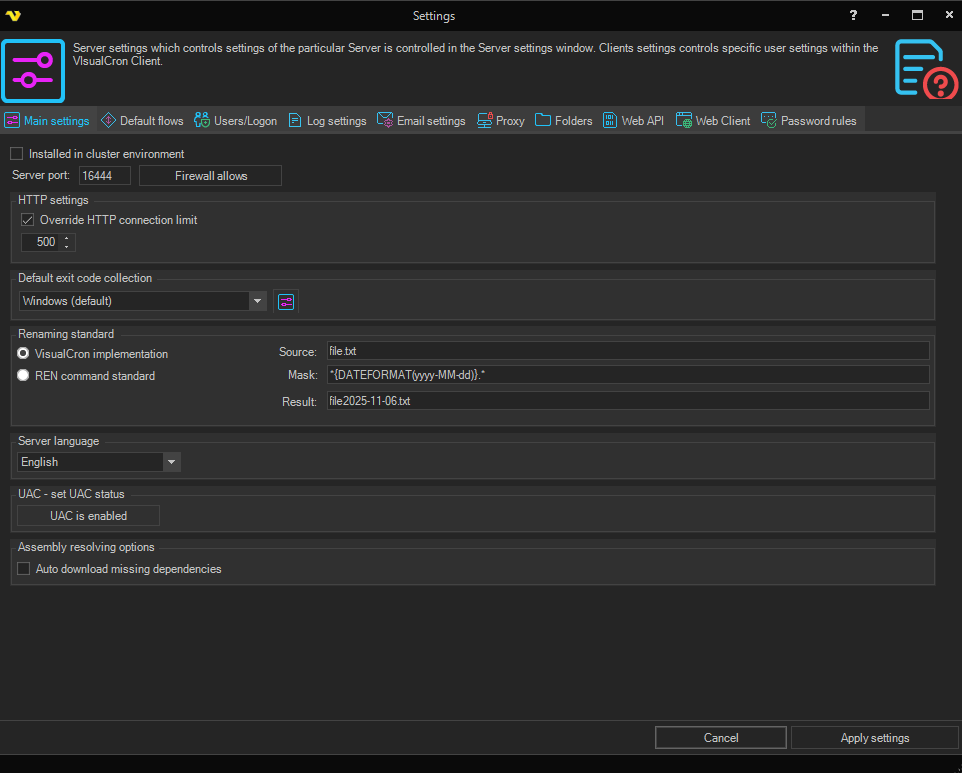
Installed in cluster environment
Check Installed in cluster environment when VisualCron is installed in a Windows failover cluster, on two nodes that share a drive. See Using VisualCron in a clustered environment.
Server port
Clients on other computers connect to the Server on this TCP port, with encrypted traffic. The default is "16444". To change it, enter a new port number.
VisualCron does not open the port in Windows Firewall by itself. The button next to Server port shows Firewall allows when VisualCron's own inbound rule for the port exists, and Firewall denies when it does not. Click Firewall denies to create the rule, and Firewall allows to remove it. A rule you created yourself under another name is not detected. The rule that VisualCron creates is named VisualCronService - <port> and allows connections from any remote address. To allow only the computers that run a Client, limit the rule's remote addresses in Windows Defender Firewall (see Firewall and network).
When you save a new port value while the button shows Firewall allows, VisualCron removes its rule for the old port and creates a new rule, VisualCronService - <port>, for the new port. The new rule allows connections from any remote address, also when you had limited the old rule, so limit its remote addresses again after a port change. If VisualCron cannot create the new rule, it creates the rule for the old port again, also open to any remote address, and the new port is still saved: no VisualCron rule then allows the new port. If the button shows Firewall denies, no rule is created for the new port. See Port and firewall.
The firewall button acts at once, without Apply settings. A new port takes effect as soon as you click Apply settings: the Server starts listening on the new port. Clients that connect from another computer must then use the new port. Change it in their server connection in File -> Servers -> Manage Servers (see Servers - Manage Servers).
If you change the port from a Client on another computer, that Client's own connection to the Server is closed. Update its server connection with the new port and connect again.
HTTP settings
Override HTTP connection limit sets how many HTTP connections the Server can have open to the same host at the same time. This matters when many HTTP requests run at once, for example from the HTTP Task. The option is checked by default with a limit of "500". You can enter a value from 2 to 10000. When the option is unchecked, the .NET default limit applies.
The Server reads this setting only when the VisualCron service starts. After you change it, restart the VisualCron service.
Default exit code collection
The exit code collection that is selected by default on the On error tab of new Tasks. The default is "Windows (default)".
Renaming standard
Some Tasks can rename files with a mask. Choose how masks are applied:
- VisualCron implementation (default): VisualCron's own renaming rules, which adjust some rules of the Windows REN command
- REN command standard: the renaming rules of the Windows REN command
Source, Mask and Result let you try a mask: enter a file name in Source and a mask in Mask, and Result shows the renamed file name. Result is calculated with the VisualCron implementation, also when REN command standard is selected.
Server language
The language the Server uses for the texts it writes, for example in its logs. The default is "English". The new language is used as soon as you click Apply settings.
UAC - set UAC status
The button shows whether User Account Control (UAC) is turned on for the Server computer: UAC is enabled or UAC is disabled. Click it to switch UAC on or off. The button changes the Windows setting at once, without Apply settings, and the change takes effect after you restart the computer. If VisualCron cannot read the status, the button shows UAC is enabled and the error is written to the Client log.
Turning UAC off lowers the security of the whole computer, not only of VisualCron. Turn it off only if your security policy allows it.
Assembly resolving options
Some Tasks use optional component files that are not installed with VisualCron. When a Task needs one of these files and it is missing, the Server can download it from the VisualCron website into the VisualCron installation folder (by default C:\Program Files (x86)\VisualCron on 64-bit Windows) and load it. The Server computer must then be able to reach the VisualCron website.
In the current version, the Server downloads these files only while Auto download missing dependencies is unchecked. While it is checked, the Server does not download them. Check the current state of the option on your Server.
- If your policy does not allow the Server to download files from the Internet, check Auto download missing dependencies and click Apply settings.
- If a Task fails because a component is missing, and your policy allows downloads, uncheck the option and click Apply settings.