Condition - VisualCron
The VisualCron condition checks the result or the state of a Job or Task on this Server: its exit code, its stored output, or whether it is running. Use it, for example, to run a Task only when the Task before it succeeded, or to skip a Job while another Job is still running.
This page describes the VisualCron tab of the Add/Edit condition window. For the Main settings tab of the window (Condition type, Description, Active), see Conditions - Conditions.
Server -> Global objects -> Conditions -> Add -> Conditions tab -> Add -> Condition type "VisualCron" -> VisualCron tab
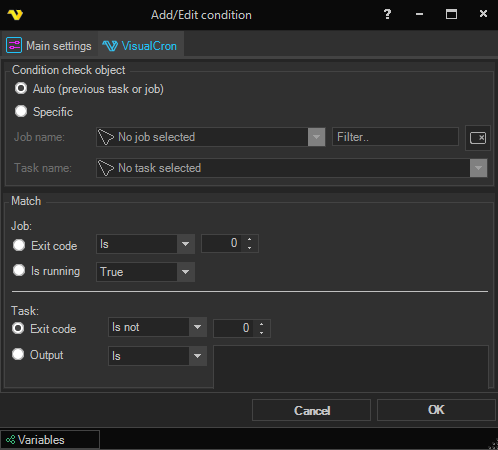
Condition check object
Choose which Job or Task the condition checks:
- Auto (previous task or job): the Task that ran before the current one, or the Job that started this Job, as described below
- Specific: the Job you select in Job name and, for the Task checks, the Task you select in Task name
Job name and Task name are enabled only when Specific is selected. Task name lists the Tasks of the selected Job and stays disabled for the Job checks. With Specific you can check a Job or Task in any Job on this Server. If the selected Job or Task no longer exists, the condition returns a Match Error.
What Auto checks
On a Task's Condition Set:
- The Task checks refer to the Task that last finished in the current run, before this Task started
- When the Job has Run Tasks in order checked, that is normally the Task above the current one. A Task that did not run, for example because its own Condition Set skipped it, does not count: the checks then use the last Task that ran before it
- When Run Tasks in order is cleared, Tasks can run at the same time, so the previous Task is whichever Task finished last
- The Job checks refer to the current Job. That Job is running, so Is running is always "True" and Exit code is always "0". Use Specific to check another Job
On a Job's Condition Set:
- The Job checks refer to the Job that started this Job, for example the Job that a VisualCron Trigger watches (see Event Trigger - VisualCron)
- The Task checks always return a Match Error
A Task's Condition Set is evaluated whether Run Tasks in order is checked or cleared. Only the meaning of "previous Task" changes.
An Auto condition returns a Match Error when there is no previous Task or Job, and the Condition Set then takes its On Match Error action. With the default On Match Error action, "Exit", the Job stops. This happens for:
- A Task check (Exit code, Output, Output (stderr) or Is running under Task) in a Job's Condition Set, every time
- The first Task of a run, including a run that starts from a selected Task, and every later Task when all the Tasks before it in the run were skipped
- Every Task that starts before any other Task of the run has finished, when Run Tasks in order is cleared
- A Job's Condition Set when no Job started the Job, for example when a time Trigger or a Condition Set's "Run Job" action starts it
Do not assign a set with an Auto condition to the first Task of a Job, or to a Task whose earlier Tasks can all be skipped, and set On Match Error to the action you want. See Conditions - Actions.
Match
Select one check. The checks under Job apply to the Job, and those under Task apply to the Task. Each check uses the Job or Task chosen under Condition check object. A new condition starts with Task Exit code, "Is not" and "0".
Job: Exit code
Compares the Job's exit code from its latest run with the number you enter, using "Is" or "Is not".
- When a Task in that run failed, the Job's exit code is the exit code of the Task that failed most recently. Whether a Task counts as failed depends on that Task's exit code settings. Only the last result of each Task counts, so a Task that fails and then succeeds in the same run, for example when it is retried, is not counted as failed
- When no Task failed, it is the exit code of the first Task that succeeded, normally "0"
- A run that ends by its timeout gets "77777", whatever its Tasks returned, when Consider timeout as error is checked on the TimeOut tab of the Job. See Job - Timeout. Any other run that is stopped, including a timeout without that setting, gets "77777" when its exit code would otherwise be "0"
The exit code is set to "0" when a run starts and is updated only when the run ends, so it reads "0" while the Job is running.
Job: Is running
Select "True" to match while the Job is running, or "False" to match while it is not.
Task: Exit code
Compares the exit code of the Task's latest run with the number you enter, using "Is" or "Is not". A Task that succeeds normally returns "0".
Task: Output and Output (stderr)
Output compares the standard output that VisualCron stored for the Task. Output (stderr) compares the stored error output. Enter the text in the box to the right, and select a match type:
- "Is": the whole stored output equals the text
- "Is not": the whole stored output differs from the text
- "Contains": the stored output contains the text
- "Not contains": the stored output does not contain the text, or no output is stored
The comparison is case-sensitive. "Is" and "Is not" compare the entire output, including line breaks at the end. You can use Variables in the text, see Global - Variables. They are replaced with the values of the Job and Task that the condition checks (with Specific, the selected Job and Task), not with those of the Job that uses the Condition Set.
With Specific, select a Task name for Output (stderr) as well. The window lets you save this check without a Task, and the condition then returns a Match Error.
Task: Is running
Select "True" to match while the Task is running, or "False" to match while it is not.
Example: run a Task only when the previous Task succeeded
- Add a Condition Set, and on its Main settings tab enter a Description, for example "Previous Task succeeded".
- On the Conditions tab, add a condition with Condition type "VisualCron".
- On the VisualCron tab, keep Auto (previous task or job), keep Exit code under Task selected, and change "Is not" to "Is", with "0".
- On the Actions tab, keep On Match All at "Continue", and keep On Match None at "Exit" to stop the Job, or change it to "Next" to skip only this Task.
- Set On Match Error to the action you want when the check cannot be made.
- Assign the set to the second Task or a later one, in a Job that has Run Tasks in order checked, on the Conditions tab of the Task window. See Task - Conditions. If the Task before it can be skipped by its own Condition Set, the check uses the last Task that ran instead.
- On the Flow tab of the Task before it, look at the On error entry. If it is set to Stop Job, the Job stops when that Task fails, the set is never checked, and step 4 has no effect. To let the set decide, set that entry to Continue to next Task in order. See Task - Flow.
New Tasks get the Flow entries defined in Settings - Default Flows.