Task SNMP - SNMP Walk
The SNMP Walk Task reads all variables in a subtree of an SNMP agent, by sending GETNEXT requests from the root OID you enter until the agent returns a variable outside the subtree. SNMP (Simple Network Management Protocol) is a UDP-based protocol used mostly by network management systems to monitor network-attached devices.
The Main settings, Flow, On error, Conditions and TimeOut tabs are the same for every Task; see Job - Tasks.
The Task settings are on the SNMP Walk tab, which has the sub tabs General, Advanced, Data and Security.
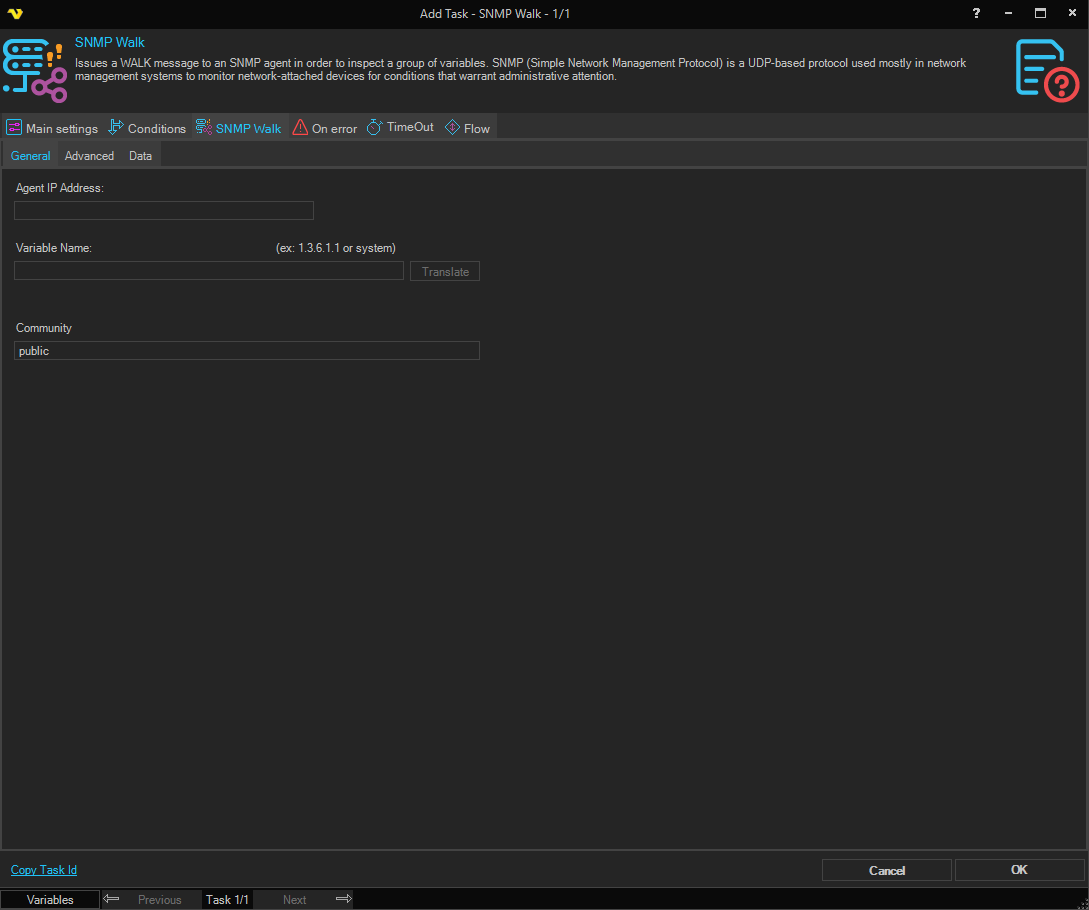
SNMP Walk: General tab
-
Agent IP Address: The IPv4 address or host name of the SNMP agent; it can contain Variables
For a host name, the Task uses its first IPv4 address. A host name that cannot be resolved stops the Task with an error.
-
Variable Name: The root OID of the subtree to read, as a number such as
1.3.6.1.2.1.1or a name such assystemNames are case-sensitive. Click Translate to show the other form of the OID you entered.
-
Community: The community string, "public" by default
With "SNMPv3" this field is labeled User and holds the SNMPv3 user name.
Variables are resolved only in Agent IP Address.
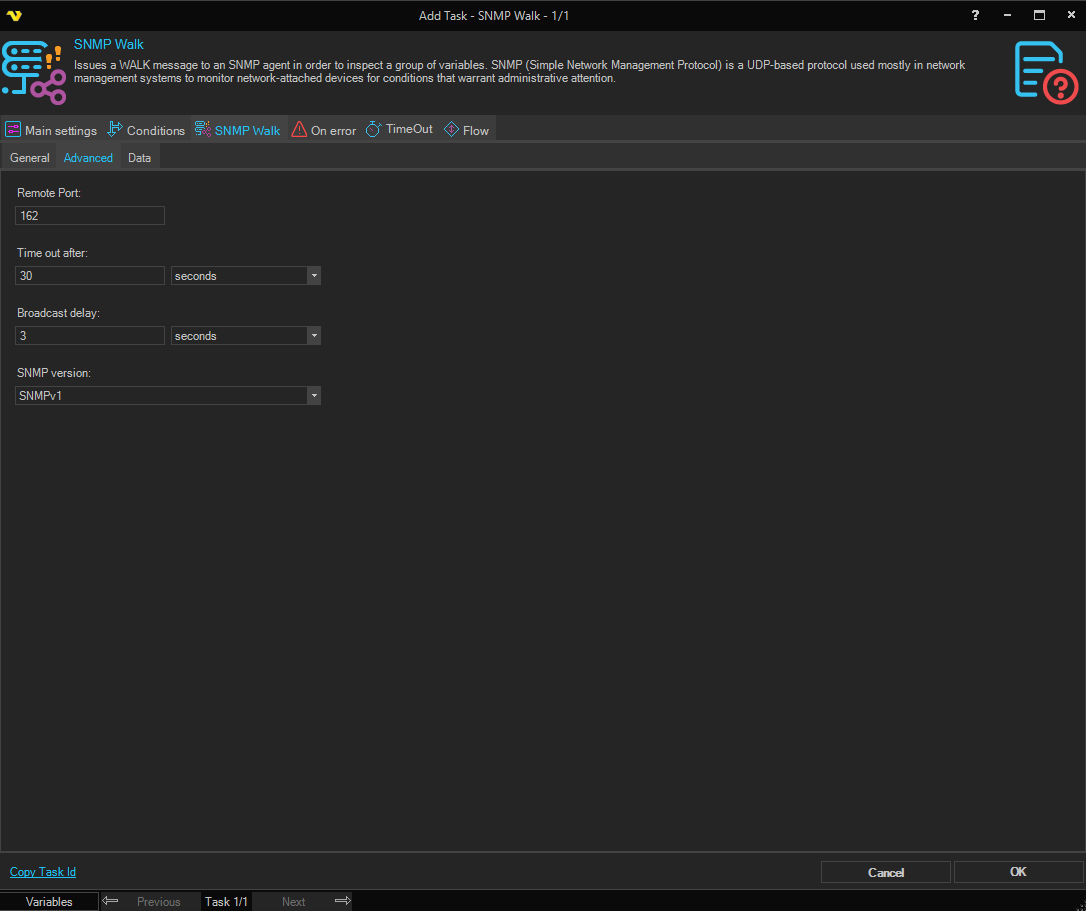
SNMP Walk: Advanced tab
-
Remote Port: The UDP port of the SNMP agent
A new Task shows "162", the port for SNMP traps. SNMP agents normally listen on port "161", so enter the port of your agent.
-
Time out after: How long to wait for the response, in "milliseconds", "seconds", "minutes" or "hours"
The default is "30" with the unit "seconds". When no response arrives in time, the Task fails with an error.
-
Broadcast delay: When Agent IP Address is the broadcast address "255.255.255.255", how long to wait for a response instead of Time out after
The default is "3" with the unit "seconds".
-
SNMP version: "SNMPv1" (the default), "SNMPv2c" or "SNMPv3"
With "SNMPv3", the Community label changes to User and the Security tab appears.
With "SNMPv3", the walk does not move past the first variable of the subtree, so the Task does not finish by itself. Use "SNMPv1" or "SNMPv2c" for a walk.
SNMP Walk: Data tab
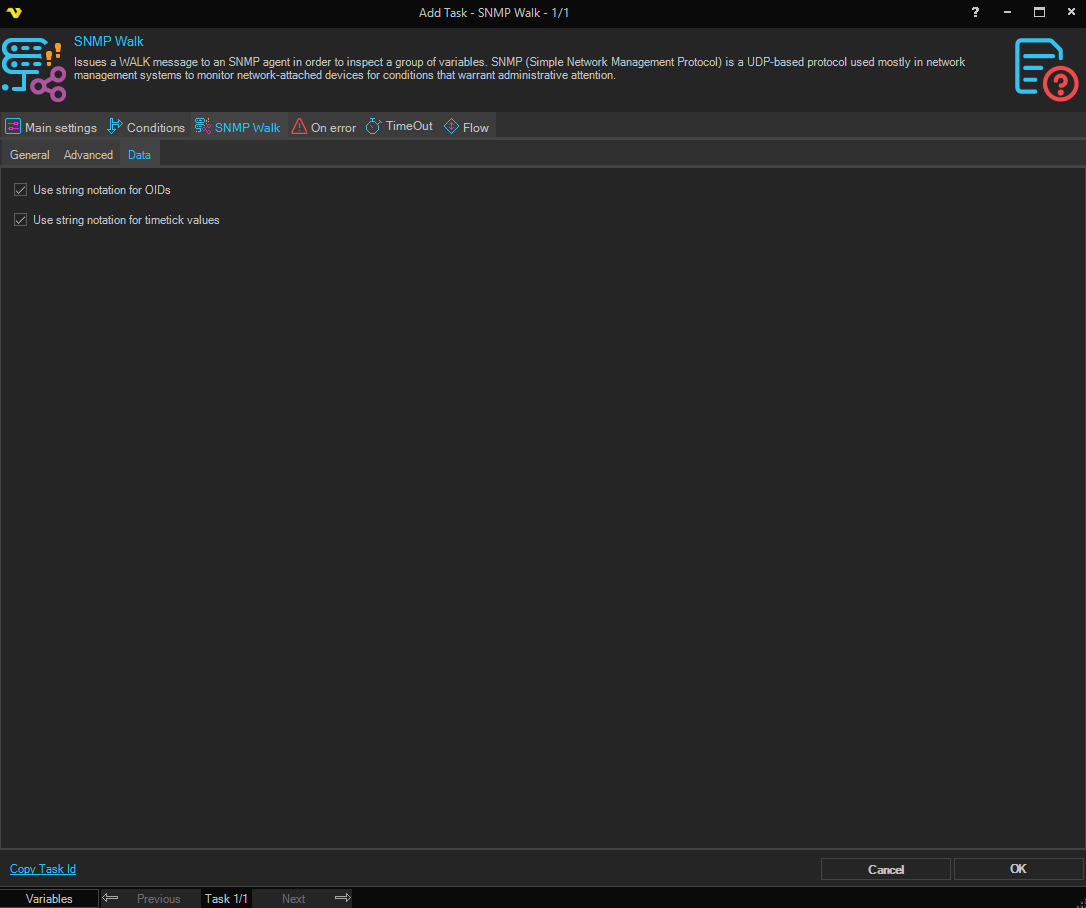
- Use string notation for OIDs: Selected by default; writes the OIDs in the output as names instead of numbers
- Use string notation for timetick values: Selected by default; writes TimeTicks values as a duration instead of a number
SNMP Walk: Security tab
The Security tab appears only with "SNMPv3" on the Advanced tab.
-
Security Level: "None" (the default), "Authenticate" or "Authenticate and Encrypt"
-
Authentication Protocol: "MD5" (the default) or "SHA-1", for "Authenticate" and "Authenticate and Encrypt"
-
Authentication Passphrase: The authentication passphrase, at least 8 characters
-
Encryption Protocol: "DES", the only choice, for "Authenticate and Encrypt"
-
Encryption Passphrase: The encryption passphrase, at least 8 characters
-
Specify Context: Enables Context Name and Context Engine ID
-
Context Name and Context Engine ID: The SNMPv3 context
This Task sends Context Name; Context Engine ID is not used.
Output and errors
The output of the Task lists the SNMP version, the community or user name, and the error status and error index of the response, then one line for each variable in this form:
<OID> = <type> : <value>
With SNMPv3, the output also lists the security parameters and the context of the response.
The walk ends at the end of the subtree or at the first response with an error status. In both cases the output holds the variables read until then, and the Task reports success. When Agent IP Address is a host name with no IPv4 address, or a variable binding cannot be converted, nothing is sent, the output stays empty, and the Task reports success. To catch this, check the output on the On error tab; see Task - On Error.
The output of the Task contains the community string (SNMPv1 and SNMPv2c) or the user name (SNMPv3) in plain text, so anyone who can see the Task output can read it. SNMPv1 and SNMPv2c also send the community string over the network unencrypted.