Task Database - SQL
The SQL Task runs a SQL command, a stored procedure or a SQL Server Agent job against a database, using a SQL Connection. The Connection can use ODBC, OLE DB or a native provider, such as the native providers for Microsoft SQL Server, Oracle, MySQL, PostgreSQL and IBM DB2.
The Query area has the sub tabs Text, Stored Procedure and Job. Only the sub tab that is active when the Task is saved is used.
This Task uses a SQL Connection; see Connection - SQL. Each time the Task runs, it sets the SSL and TLS versions for the whole VisualCron Server process to the versions selected on the Connection, and the Server then accepts any server certificate for HTTPS calls in the Server process.
The Main settings, Flow, On error, Conditions and TimeOut tabs are the same for every Task; see Job - Tasks.
With a native Microsoft SQL Server Connection and Add info messages to output selected on the Output tab, SQL Server reports most errors in the query (severity 16 or lower) as messages instead of errors. They are added to the output, and the Task reports success. Clear Add info messages to output when the Task must fail on such errors, or add an error condition on the output on the On error tab; see Task - On Error.
SQL tab
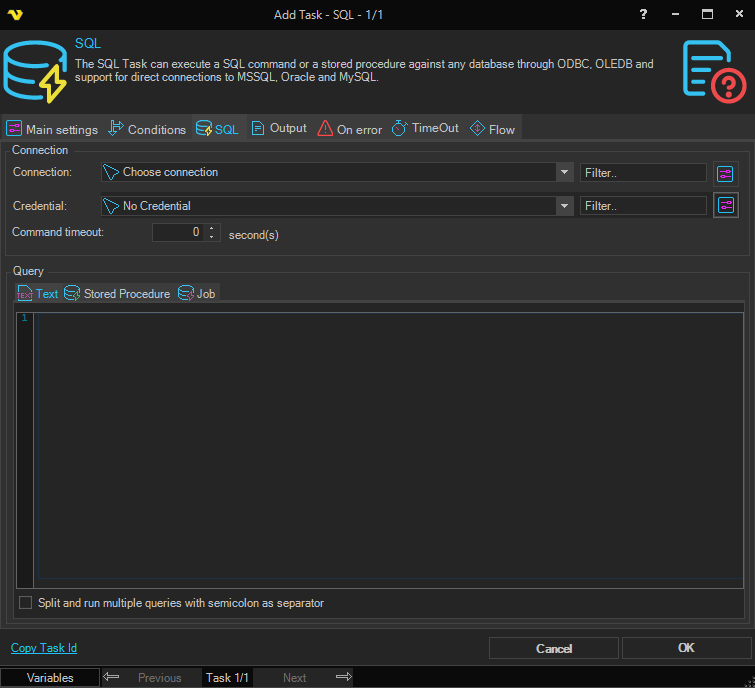
Connection
- Connection: The SQL Connection to the database. Select a Connection in the list, or click the icon next to it to open Manage Connections; see Global - Connections
- Credential: The Windows user the Task runs the query as. Use it with a Connection that uses Windows authentication (a trusted connection). For a local database, the Credential must be a valid Windows user on the VisualCron Server; for a remote database, a valid user on the database server. See Global - Credentials
- Command timeout: The number of seconds a query may run before it is stopped. "0", the default, means no time limit
Text sub tab
- The SQL command to run. Variables can be used in the text
- Split and run multiple queries with semicolon as separator: When selected, the text is split at each semicolon, and each part is run as a separate query, in order. The text is split at every semicolon, also at a semicolon inside a quoted value or inside the body of a procedure
Stored Procedure sub tab
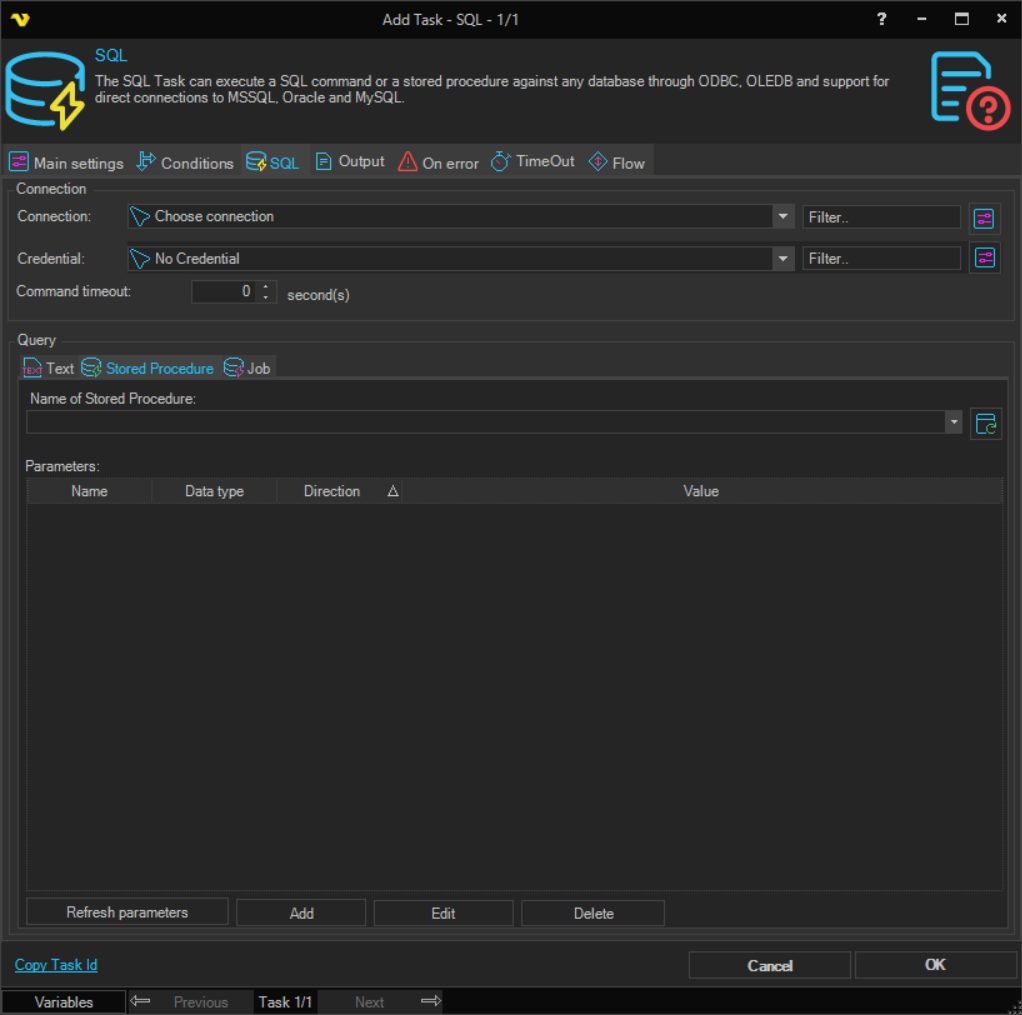
- Name of Stored Procedure: The stored procedure to run. Click the icon next to the list to load the stored procedures of the database
- Parameters: The parameters of the stored procedure, with their Name, Data type, Direction and Value. Click Refresh parameters to load them from the database. Use Add, Edit and Delete to change the list

In the parameter window:
- Name: The name of the parameter, with the prefix the database uses, normally
@ - Value: The value of the parameter. Variables can be used
- Use null value: When selected, NULL is sent instead of Value
- Validate value: When selected, the Client checks that Value matches the data type. Clear it when Value is a Variable that has no value yet
- Data type: The data type of the parameter. The list depends on the provider of the Connection
- Parameter direction: "Input", "Output", "InputOutput" or "ReturnValue"
- Size: "Auto", "Max", or "Specific" with the size in the field next to it
With ODBC, add the parameters in the order in which the stored procedure uses them.
Date and time parameter values
How the Task sends the Value of a date or time parameter depends on the provider of the Connection. Where the steps below say that the value is read, VisualCron tries, in this order:
- The primary format that the provider and data type use
- A fixed list of year-first formats, the same on every Server:
yyyyMMddHHmmss,yyyyMMdd,yyyy-MM-dd HH:mm:ss,yyyy-MM-ddTHH:mm:ss.fff,yyyy-MM-ddTHH:mm:ss,yyyy-MM-dd - The date and time patterns of the Server's current culture
- A general date parse with the Server's current culture
A value that none of these match ends the Task with an error. In steps 3 and 4, a value such as 03/04/2026 follows the day and month order of the Server's culture. For the same result on every Server, use the primary format or a format from the fixed list.
- Native Microsoft SQL Server: A "DateTime" value is read, with the primary format
yyyyMMddHHmmss. Other date and time data types, such as "Date", "DateTime2", "SmallDateTime" and "Time", are sent as text, and SQL Server converts them. For these, use a format that SQL Server reads in any language setting, such asyyyy-MM-ddoryyyy-MM-ddTHH:mm:ss - OLE DB: A "Date" value is read with the primary format
yyyyMMddHHmmssand sent asyyyy-MM-dd HH:mm:ss. A "DBDate" value is read with the primary formatyyyyMMddand sent asyyyy-MM-dd. A "DBTime" value must be exactlyHHmmss, and is sent asHH:mm:ss - ODBC, with Convert data types cleared on the Connection (the default): The value is sent as entered
- ODBC, with Convert data types selected: A "Date" value must be in one of the forms
yyyyMMdd,yyyy-MM-dd,dd-MM-yyyy,MM/dd/yyyy,dd/MM/yyyyoryyyy/MM/dd, tried in that order, so03/04/2026is read as March 4. A "DateTime" or "SmallDateTime" value must be exactlyyyyyMMddHHmmss - Oracle and MySQL with a native provider: A "DateTime" value is read, with the primary format
yyyyMMddHHmmss - IBM DB2 with a native provider: A "DateTime" value is read, with the primary format
yyyyMMddHHmmss - PostgreSQL with a native provider: The value is sent as text. With Convert data types selected, Variables in the value of a date or time parameter may not be replaced
With ODBC and Convert data types selected on the Connection, a "Date", "DateTime" or "SmallDateTime" value in any other form is sent as NULL. No error is raised, and the Task reports success.
With OLE DB and Convert data types selected, parameters of data type "Date" and "DBTime" currently end the Task with a format error. Use "DBDate" for dates, or a text data type, instead.
Job sub tab
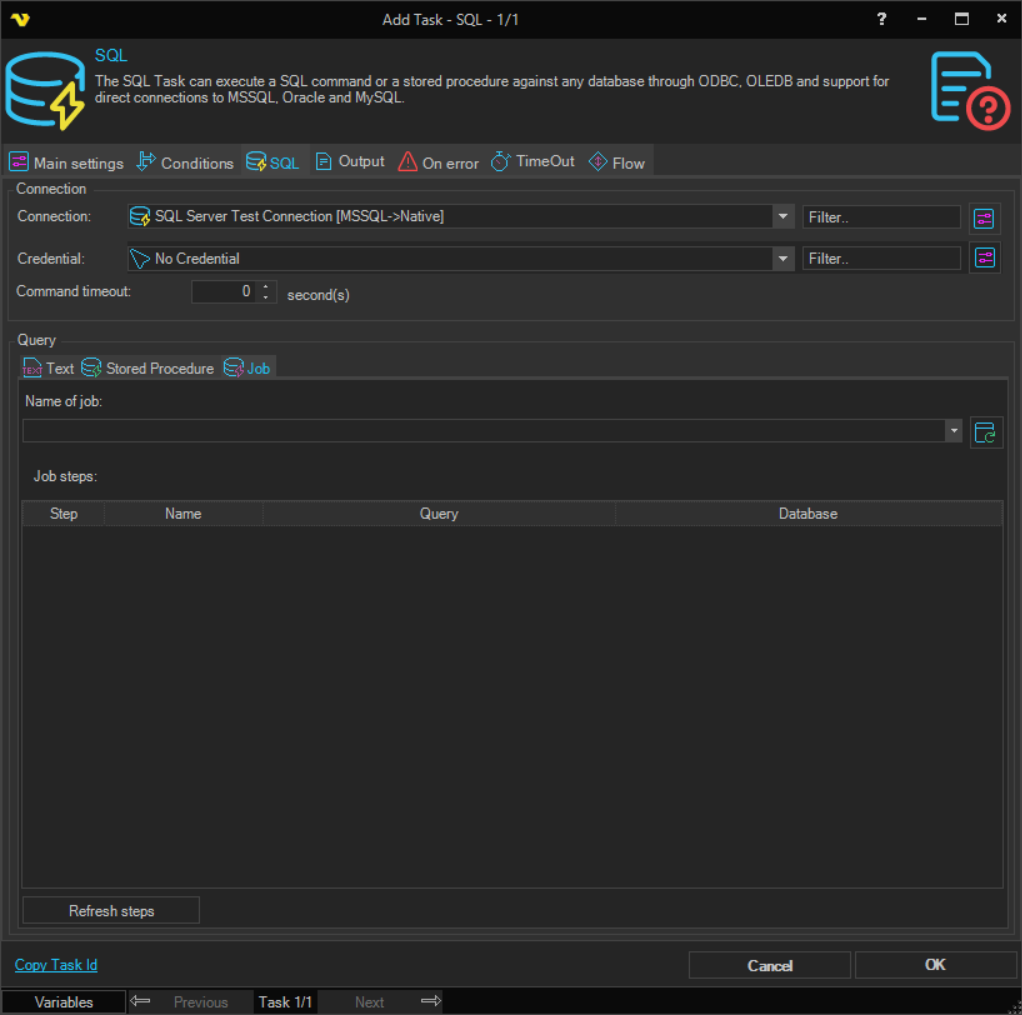
The Job sub tab runs a SQL Server Agent job, and works only with Microsoft SQL Server. Use it, for example, to run an SSIS or DTS package on a remote server: create a SQL Server Agent job for the package first.
- Name of job: The SQL Server Agent job to run. Click the icon next to the list to load the jobs of the server
- Job steps: A read-only list of the steps of the selected job, with the Step, Name, Query and Database of each step. Click Refresh steps to load them again
Output tab
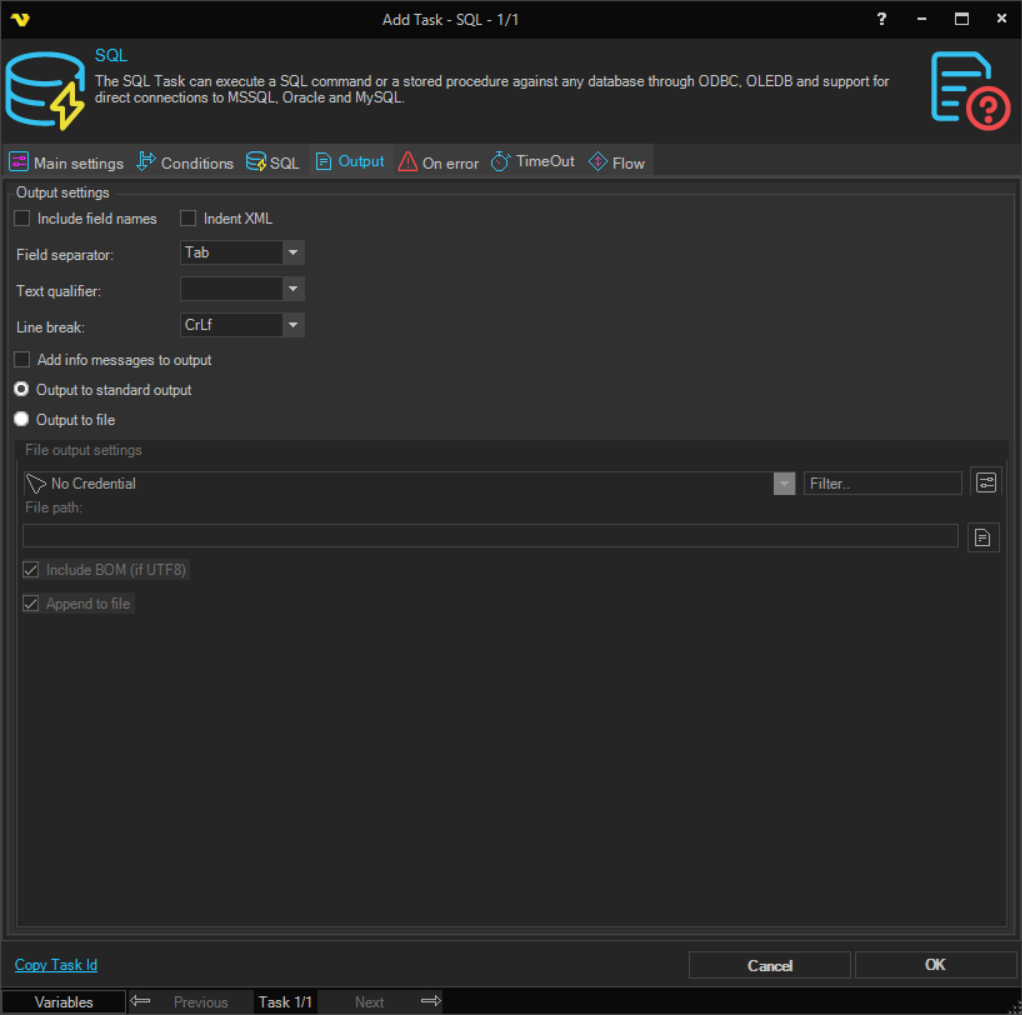
The Output tab sets how the rows that the query returns are written.
Output settings
- Include field names: When selected, the first line contains the column names
- Indent XML: When selected, XML that the query returns is written with indentation. It applies with Output to file
- Field separator: The character between the fields of a row
- Text qualifier: The character around each field value. The default is none
- Line break: The characters between the rows
- Add info messages to output: When selected, the messages of the database server, such as
PRINToutput and warnings, are added to the output. With a native Microsoft SQL Server Connection, most errors are then reported as messages; see the warning at the top of this page - Output to standard output: The default. The rows are written to the standard output of the Task
- Output to file: The rows are written to a file, and the output of the Task is the path of the file. The File output settings are then available
File output settings
- Credential: The Credential used to write the file. See Global - Credentials
- File path: The full path of the output file
- Include BOM (if UTF8): When selected, a byte order mark is written at the start of the file when the file is written as UTF-8
- Append to file: When selected, the default, the rows are added to the end of the file. When cleared, the file is replaced
With Append to file cleared, an existing file at File path is replaced on each run.
- Write buffer size: The size in bytes of the write buffer for the file. The default is "65536"
- Test the Task in the Client before you save it; errors are shown in the log window
- Use the predefined connection strings and the data sources (DSN) of the Server where you can
- For a PL/SQL statement on Oracle, put it in a
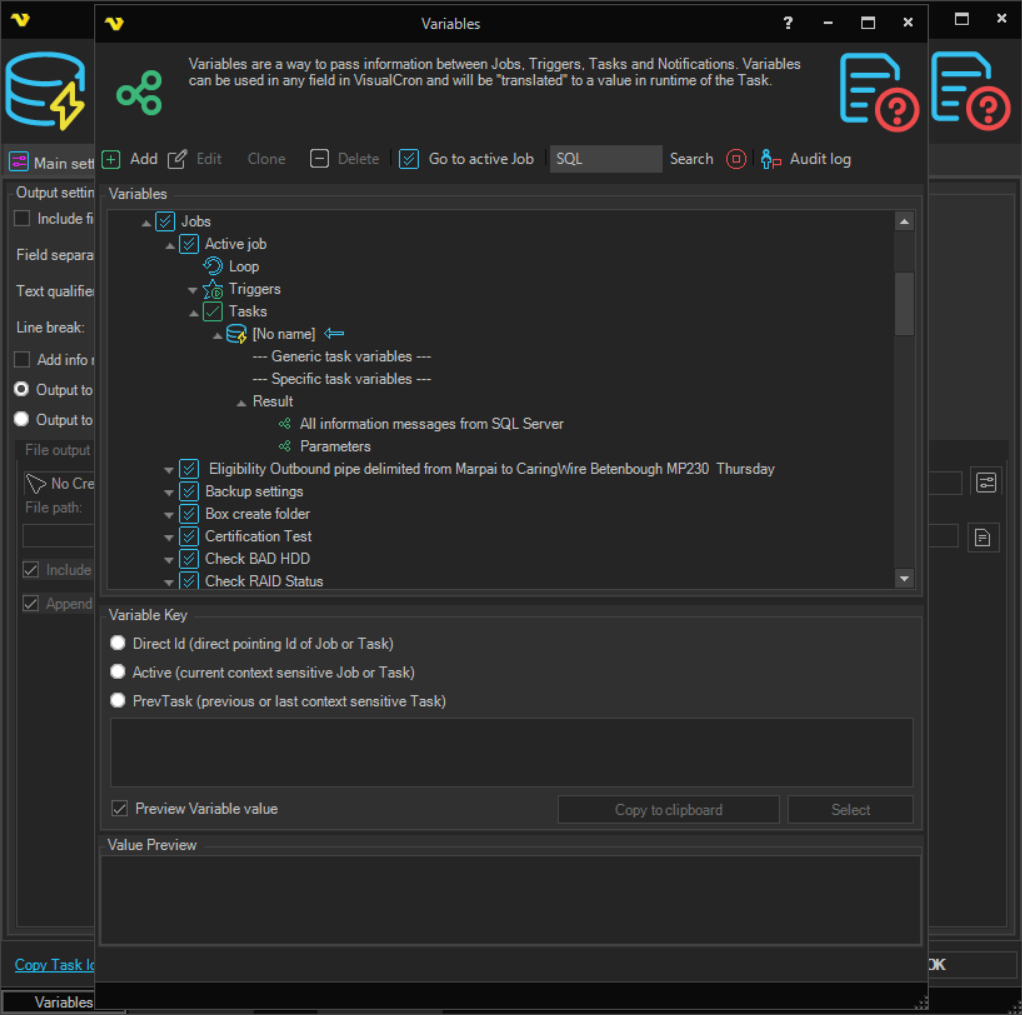
BEGIN ... END;block, for example:BEGIN FM.MQ.ADD_MSG_DIRECT('FORM','LV_SENDER','LV_POSN_UPLOAD',213,'ORG_ID'); END; - To get the values of output parameters and the messages of the server, use the result Variables of the Task, shown below
Troubleshooting
ODBC->ERROR [42000] [Microsoft][ODBC SQL Server Driver][SQL Server]Invalid parameter 1 (''): Data type 0x23 is a deprecated large object, or LOB, but is marked as output parameter. Deprecated types are not supported as output parameters. Use current large object types instead.
- Change the data type from "Text" to "VarChar" or "NVarChar"
- Make sure the size of the parameter is exactly the size of the parameter in SQL Server
The Size property has an invalid size of 0.
Set Size to "Specific", with exactly the size of the parameter.
ORA-03113
Upgrade to the latest version of VisualCron.