Event Trigger - Event Log
The Event log Trigger fires when an entry is written to a Windows event log, on the Server computer or on a remote computer. Conditions on the log, the event ID, the source, the level and the description select which entries fire it.
The Trigger reads the event log through the Windows Event Log service, not through WMI, and receives entries as they are written. To watch another computer, enter its name or IP address in Computer name on Main settings and select a Credential under Credentials. To view the logs, open Event Viewer (eventvwr.msc).
The settings are on the Event log tab.
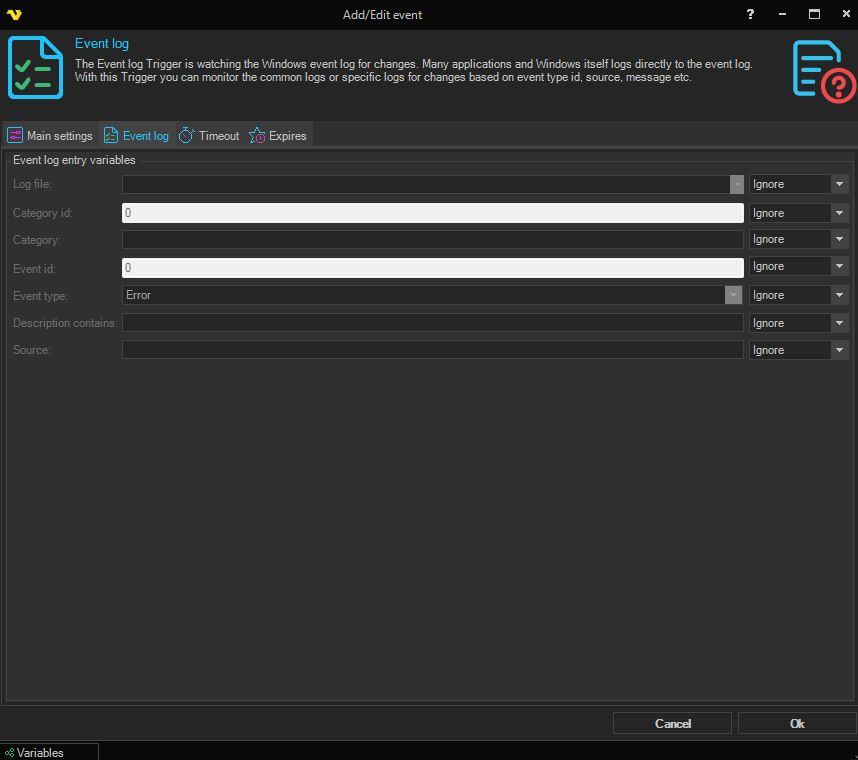
Each condition has an operator list next to it: Ignore, AND or OR. Ignore turns the condition off; AND and OR turn it on and make its field available. Description contains offers only Ignore and AND. A new Trigger has every condition set to Ignore.
The conditions combine as follows:
- An entry must match every condition set to AND
- An entry that matches a condition set to OR fires the Trigger, even if it does not match a condition set to AND
- A condition set to OR that an entry does not match does not exclude the entry; if you use only OR conditions, every entry fires the Trigger
With every condition set to Ignore, each entry written to the Application log fires the Trigger. Set at least one condition to AND to select the entries, and use OR only when any single match should fire the Trigger.
Log file
The event log to watch. The list shows the classic logs of the Server, such as "Application", "Security" and "System". You can also type a log name, for example a full channel name such as Microsoft-Windows-TaskScheduler/Operational. Set the operator to AND. The name must match exactly, including case, so select it from the list or copy it from Event Viewer. With Ignore, the Trigger watches only the Application log. With OR, every entry of the log fires the Trigger, because the Trigger receives only entries from that log. The field can contain Variables.
Category id
The task category number of the entry. Event Viewer shows the category as text in Task Category; the number is the Task value in the entry's XML view on the Details tab. Enter a number.
Category
Compared with the same task category number as Category id, not with the category text, so text such as "Logon" never matches. Use Category id instead.
Event id
The event ID that Event Viewer shows in the Event ID column, for example 7036. Enter a number.
Event type
The level of the entry. The list offers Error, Warning, Information, SuccessAudit and FailureAudit. The Trigger compares the number of the selected type with the entry's level, so the types match these Event Viewer levels:
| Event type | Matches entries with the level |
|---|---|
| Error | Critical |
| Warning | Error |
| Information | Information |
| SuccessAudit | none |
| FailureAudit | none |
To react to entries that Event Viewer shows as Error, select Warning. No type matches Warning or Verbose entries. No type matches entries with level 0 either. These include Security log audit entries and other entries that Event Viewer shows as Information. Select those entries by Event id or Source instead, for example Event id 4625 for a failed logon.
Description contains
Text that must appear in the entry's description, the message that Event Viewer shows on the General tab. The comparison is case-sensitive. Only Ignore and AND are available. The field can contain Variables.
Source
The name of the provider that wrote the entry, for example "Service Control Manager". Copy it from the Name of Provider in the entry's XML view on the Details tab. It must match exactly, including case. The field can contain Variables.
Some entries cannot be compared with a condition: an entry without a task category (Category id), an entry without a level (Event type), or an entry whose description cannot be read (Description contains), for example because the message file of its source is not installed, which is common for entries read from a remote computer. For such an entry, VisualCron logs an error, the entry passes that condition, and the conditions below it on the tab, such as Source, are not checked. If such entries fire the Trigger, set a condition above it on the tab, such as Log file or Event id, to AND so that it still selects the entries.
This setting is on the Main settings tab.
Polling interval
The Trigger does not poll for entries. If it cannot start reading the log, for example because the remote computer is not available, it tries again after this many seconds (default 60). After three failed attempts, the Trigger is deactivated.
Result Variables
Each time the Trigger fires, it sets result Variables for the entry, for example its event ID, {TRIGGER(Active|LastTrigger|EventLog.Result.EventId)}. With Last trigger (Active|LastTrigger), a Variable reads the result of the firing that started the run. All Event log Trigger result Variables are described in Variables.