Connection - FTP
The FTP Connection stores connect and logon properties for normal and secure FTP server connections.
About FTP
File Transfer Protocol (FTP) is a standard network protocol used to transfer files from one host to another host over a TCP-based network, such as the Internet.
FTP is built on a client-server architecture and uses separate control and data connections between the client and the server. FTP users may authenticate themselves using a clear-text sign-in protocol, normally in the form of a username and password, but can connect anonymously if the server is configured to allow it. For secure transmission that hides (encrypts) the username and password, and encrypts the content, FTP is often secured with SSL/TLS ("FTPS"). SSH File Transfer Protocol ("SFTP") is sometimes also used instead, but is technologically different.
The first FTP client applications were command-line applications developed before operating systems had graphical user interfaces, and are still shipped with most Windows, Unix, and Linux operating systems. Dozens of FTP clients and automation utilities have since been developed for desktops, servers, mobile devices, and hardware, and FTP has been incorporated into hundreds of productivity applications, such as Web page editors.
"Implicit SSL" versus "explicit SSL" (per RFC 2228)
Connecting securely and authenticating are two distinct methods of establishing a secure connection with a FTP server. In the first case, the Secure FTP server may first require a SSL connection to be established, before the initial welcome message is sent. This is called an implicit SSL connection. In the second case, the connection is established in clear text and a special FTP command must be sent to the Secure FTP server to change the connection into a secure connection. This is called an explicit SSL connection.
In most cases, FTP servers that support SSL authentication will accept a normal connection on port 21. Once the connection is established, it is necessary to authenticate before logging in, using the Authenticate method. When explicitly securing the connection, it is also possible to secure data connections using the overload of the Authenticate method which requires a DataChannelProtection ENUM as a parameter.
Servers that require an implicit SSL connection usually listen on port 990 rather than 21
Protocol variants
- FTP
- FTP SSL Explicit
- FTP SSL Implicit
- FTP TLS Explicit
- FTP TLS Implicit
The FTP Connection stores connect and logon properties for normal and secure FTP server connections.
Manage Connections > Add > FTP > Common settings tab

Protocol type
VisualCron is able to connect using regular FTP and FTPS (with implicit and explicit encryption). Regular FTP offer no security and information is not encrypted. VisualCron supports both SSL 3.0 and TLS (SSL 3.1). SSL and TLS are protocols layered above connection protocols (such as TCP/IP) but beneath application protocols (such as FTP) that provide encrypted, authenticated communications between a client and a server.
Brute force test
When using FTP and you are unsure of connection properties you can use the Brute force test tool to test all connection combinations. Note, brute force test option is only available for FTP protocol.
Name
This is a descriptive name of the connection to distinguish from other connections.
Group
The group that the connection is a part of
Timeout
The connection timeout in seconds. Connection will fail after this time is passed.
Code page
The table of values that describes the desired character set.
Manage Connections > Add > FTP > Connection Settings tab
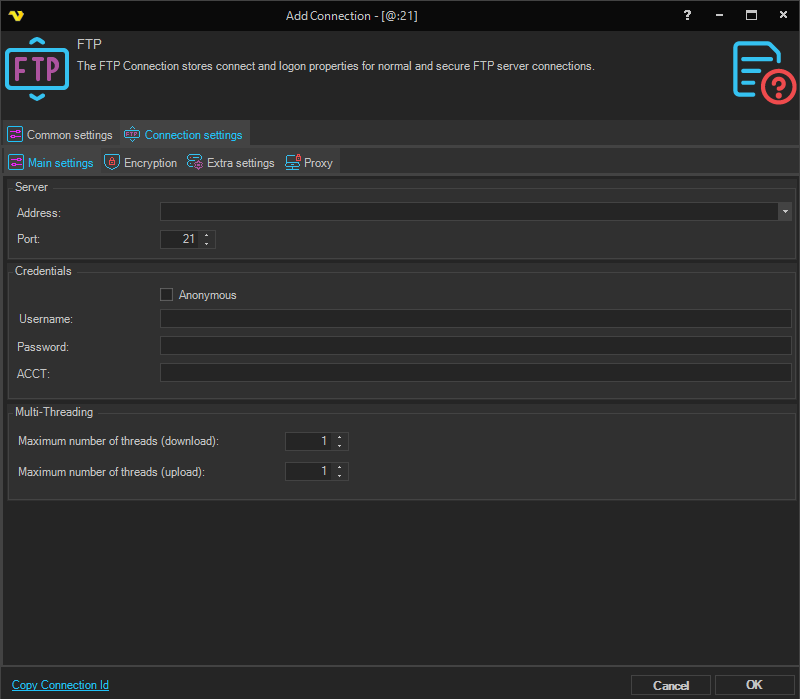
Address
This is the host address to the server. It could be a DNS name or IP number.
Port
This is the remote connection port. Default port for regular FTP is 21. Default port for Implicit FTPS is 990.
Anonymous
If your connection does not require a user name and password this box should be checked. When checked, the Username, Password, and ACCT fields are disabled.
Username
The user name for the connection.
Password
The password for the connection.
ACCT
This property is only for some proxies that require ACCT value. FTP protocol only.
Maximum number of threads (download)
The maximum number of concurrent download threads. Minimum is 1, maximum is 8, default is 1.
Maximum number of threads (upload)
The maximum number of concurrent upload threads. Minimum is 1, maximum is 8, default is 1.
Manage Connections > Add > FTP > Encryption tab
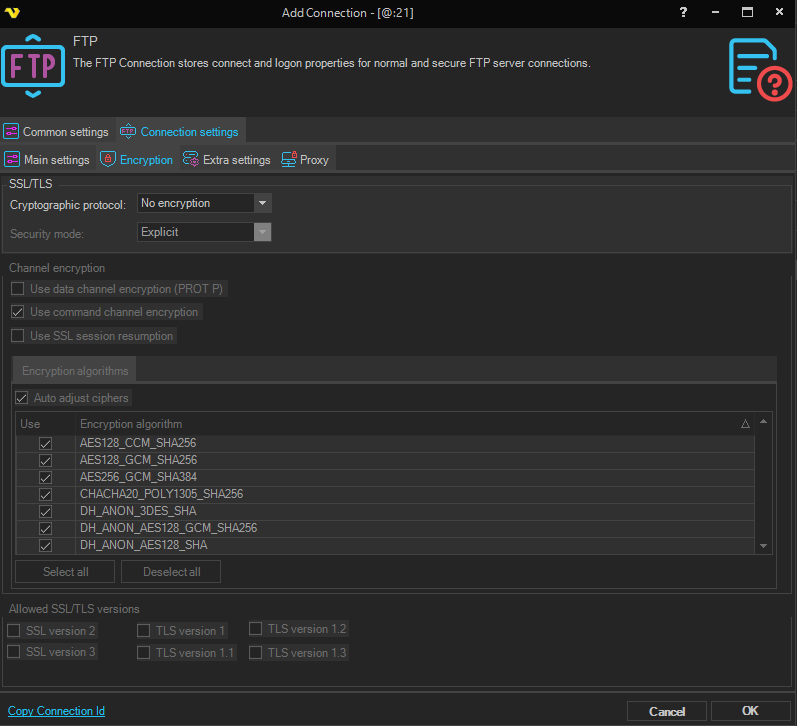
Cryptographic protocol
Select the encryption protocol. Available options:
- No encryption - standard FTP with no encryption; disables all other Encryption tab settings and hides the Certificates tab
- SSL - uses SSL encryption; enables security mode, channel encryption options, SSL/TLS version selection, and the Certificates tab
- TLS - uses TLS encryption; enables security mode, channel encryption options, SSL/TLS version selection, and the Certificates tab
Security mode
Select the connection mode. Only enabled when a cryptographic protocol is selected:
- Explicit - the connection starts in clear text and upgrades to encrypted using AUTH TLS/SSL (default port 21)
- Implicit - the connection is encrypted from the start (default port 990; port is automatically set to 990 when Implicit is selected on a new connection)
Use data channel encryption (PROT P)
If this property value is True the channel used for data transfer (files, directory listings) will be encrypted, otherwise only command channel will be encrypted.
Use command channel encryption
If this property value is True the command channel will be encrypted.
Use SSL session resumption
Specifices if SSL session resumption should be used.
Auto adjust ciphers
When checked, VisualCron automatically selects the encryption cipher suites. When unchecked, the cipher suite grid is enabled and you can manually select which algorithms to allow using the Select all and Deselect all buttons.
Allowed SSL/TLS versions
Select which SSL/TLS protocol versions are permitted for this connection:
- SSL version 2
- SSL version 3
- TLS version 1
- TLS version 1.1
- TLS version 1.2
- TLS version 1.3
For the FTP SSL/TLS connection types, an extra Certificates tab is provided.
Manage Connections > Add > FTP SSL/TLS > Certificates tab
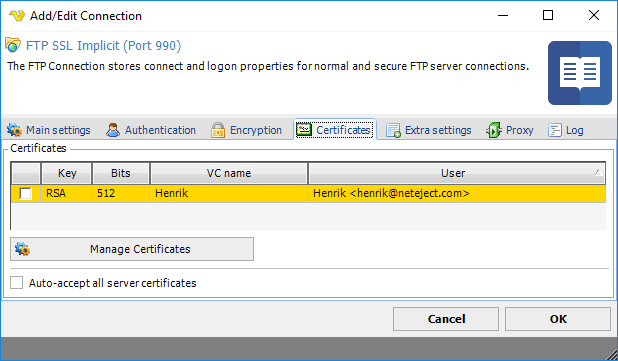
Client certificates
Client certificates can be sent to the FTP server when connecting (implicit SSL) or when authenticating (explicit SSL). If the client certificate should be rejected by the server, an exception will be issued and the Task can not continue.
To add a client certificate, you need to click on Global Certificates. VisualCron is able to store certificates within itself. These certificates can be created by VisualCron or imported from other source. When you have create a Certificate you need to select it in the list of Certificates in the Certificates tab of the Connection properties.
Server certificates
The certificate that is received from the FTP server is verified against the VerificationFlags provided at connection or authentication. By default, if a certificate received from an FTP server contains anomalies, it will be rejected. If no anomalies are detected, it will be accepted. This behavior can be overridden by checking the Auto-accept server certificates checkbox. If not checked and a certificate anomaly is detected, a popup will be shown (if the client is logged in). The popup message will show why the server certificate was initially connected. You can choose to "Accept" or "Deny" the certificate. If accepted, it will be saved and you will not be asked again unless the server certificate has changed.
Manage Connections > Add > FTP > Extra settings tab
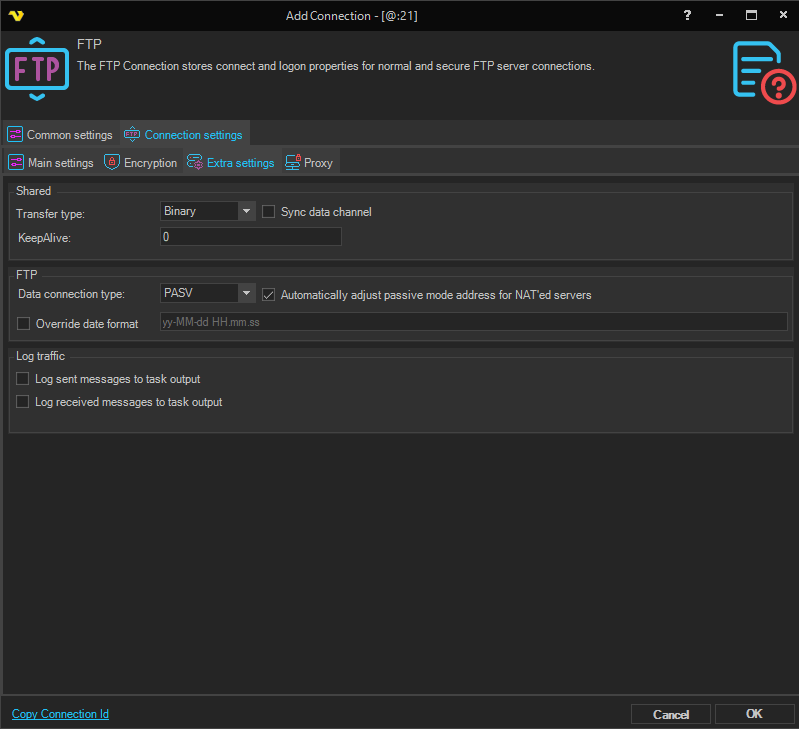
Transfer type
Select if you want to transfer through binary (default) or ASCII mode.
Sync data channel
This option specifies whether to synchronize data channel. Switch it on if component hangs when trying to establish data connection, i.e., on using commands list, upload, download. Only enabled when a cryptographic protocol is selected.
KeepAlive
The interval (in seconds) for sending keepalive signals to maintain the connection.
Data connection type
This value is indicating if the FTP client should initiate the data connection rather than the FTP server.
If set to PASV, the PASV command will be sent to the FTP server rather than the PORT command. This results in that the FTP server will listen on a data port (other than its default) and wait for a data connection to be established by the FTP client. The reply to the PASV command includes the host and port address the FTP server is listening on.
If set to PORT, the PORT command will be sent and the FTP client will listen for an incoming data connection.
The FTP server will establish the data connection upon receipt of a transfer command.
If you are having problems with connecting or sending/receiving files to/from a server, try the PASV setting.
Automatically adjust passive mode addres for NAT'ed servers
If this property is set to True, in passive mode data transfer, VisualCron will automatically set the address of the remote host to that from the control connection.
Override date format
VisualCron is trying to interpret the dateformat of files when listing files. In some situations there is a compatibility or a FTP server not behaving according to standard. In these cases you will see an error in the log file which contains the incoming date format. By overriding and using the same format as in the log you will force VisualCron to use this specific date format. When checked, the date format text field is enabled (default format: yy-MM-dd HH.mm.ss).
Log sent messages to task output
When checked, all messages sent from VisualCron to the FTP server are logged and stored in the Task output.
Log received messages to task output
When checked, all messages received from the FTP server are logged and stored in the Task output.
Proxy tab
Proxy servers allow a client to make indirect network connections. The client connects to the proxy, makes a request for a connection, file, etc. The proxy server then provides this resource by getting it from the requested address or by retrieving it from its cache. The advantages of using a proxy server can include filtering, connection sharing, increased speed and decreased bandwidth use. HTTP proxy servers are web servers that relay requests from a client to an external FTP server.
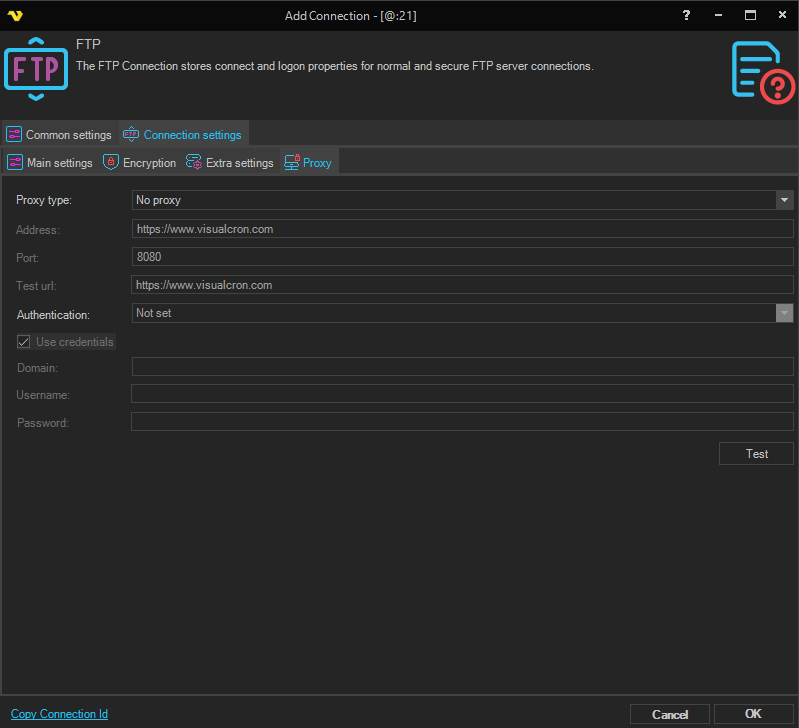
Proxy type
Select the proxy type to be used.The FTP implementation supports the HTTP proxy type and the SFTP implementation supports the SOCKS4 and SOCKS5 proxy types.
Address
The host name or IP address of the proxy server.
Port
The port of the proxy server.
Use credentials
The credentials that are associated with the account.
Domain
The name of the domain to be created.
Username
The user name to access the proxy server.
Password
The password to access the proxy server.
Use proxy for data channel
By default, proxy is used for the data (sending channel). Uncheck this to circumvent proxy.
Log tab This tab is not applicable for the email related (SMTP, POP3 and IMAP4) or SQL connection types.
Manage Connections > Add > FTP > Log tab

Log outgoing messages to Task output
All messages sent from VisualCron to the FTP server is logged and stored in the Task output.
Log incoming messages to Task output
All messages received from VisualCron to the FTP server is logged and stored in the Task output.
Troubleshooting
Control channel transfer error (error code is 10053)
Try checking Auto accept all server certificates in Certificates tab. If you get this error on upload you can alternatively check Use SSL session resumption.
Server cannot perform SSL/TLS negotiation
FTP server either does not support TLS or SSL. Try switching between those.
10035 / 114690 / 425 error. Can connect but not list files. / Connection timeout after MLSD is sent
Try unchecking "Automatically adjust PASV for NATed servers"
534 Protection level negotiation failed
Check "Use data channel encryption (PROT P).
SSL Error: 73732
Make sure you checked the correct SSL version. Preferably only TLS 1.2.
Error: 75796
Try manually selecting the encryption algorithm.