Connection - SQL
The SQL Connection stores database connection properties for use in the Database - SQL Task and the Event trigger - SQL Trigger.
The SQL Connection is configured through a wizard with three starting options:
Manage Connections > Add > SQL > Wizard
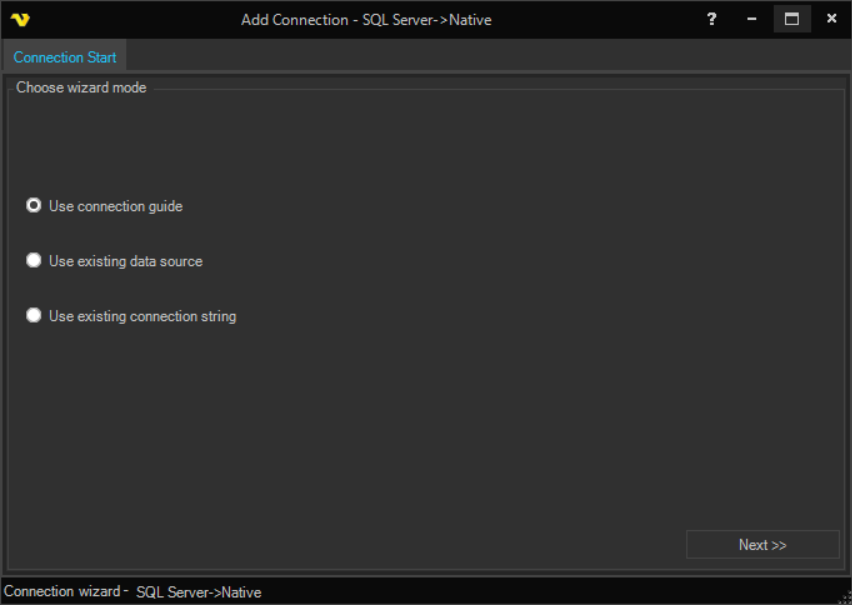
Use connection guide
Starts a guided wizard that builds the connection string based on your database type and provider. Recommended for new connections.
Use existing data source
Lets you select from existing ODBC data sources listed under System DSN.
Use existing connection string
Lets you enter a connection string directly if you already have one.
Use connection guide
Manage Connections > Add > SQL > Guide 1 - Step 1

Storage type
The type of data storage to connect to. Available options:
- Database - a standard relational database (most common)
- File - a file-based data source such as Excel or Access
- Other - other data source types
Database type
The specific database system to connect to. Supported types include: MSSQL, Oracle, MySQL, Snowflake, IBM DB2, PostgreSQL, SQLite, Sybase, Informix, Interbase, Firebird, Teradata, AS400, Amazon Aurora, Excel, Access, and many others.
Data provider
The driver or library used to connect to the database. Available options:
- ODBC - connect via ODBC driver; works with most database types
- OLEDB - connect via OLE DB provider; works with most database types
- Native MSSQL - direct connection to Microsoft SQL Server (faster than ODBC/OLEDB)
- Native MySQL - direct connection to MySQL
- Native Oracle - direct connection to Oracle
- Native DB2 - direct connection to IBM DB2
- Native PostgreSQL - direct connection to PostgreSQL
A direct (native) connection is faster than using ODBC or OLEDB.
Allowed SSL/TLS versions
Select which SSL/TLS protocol versions are permitted for this connection:
- SSL version 3
- TLS version 1
- TLS version 1.1
- TLS version 1.2
- TLS version 1.3
Manage Connections > Add > SQL > Guide 1 - Step 2
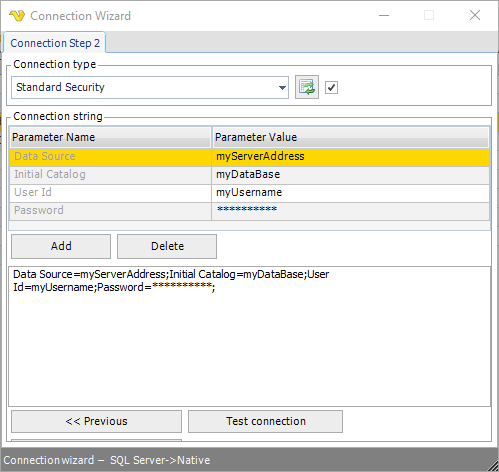
Select a connection type from the Connection type list. The connection string grid is populated with the relevant parameters for the selected type. Edit the parameter values (server, username, password, database, etc.) as needed. The connection string is updated in real time as parameters are edited. Click the Refresh icon to reload the parameters. Click Test connection to verify the connection before saving.
To use a trusted (Windows) connection, you may also need to select a Credential in the SQL Task. When testing the connection now, it runs as the currently logged-in user. When the SQL Task executes on a schedule it normally runs as SYSTEM, so a Credential may be required at the Task level.
Manage Connections > Add > SQL > Guide 1 - Step 3

Enter a name for the Connection and optionally assign it to a group.
Convert data types
When checked and using stored procedures with OLEDB or ODBC, VisualCron will attempt to convert values to their specified data types. This is generally only needed for certain databases such as Sybase or SAP.
Use existing data source
Manage Connections > Add > SQL > Guide 2 - Step 1

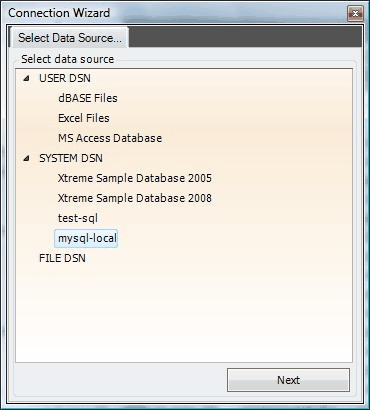
Select the System DSN you want to use. Only System DSN entries are shown — User DSN entries are not available across users and cannot be used by VisualCron.
Manage Connections > Add > SQL > Guide 2 - Step 2
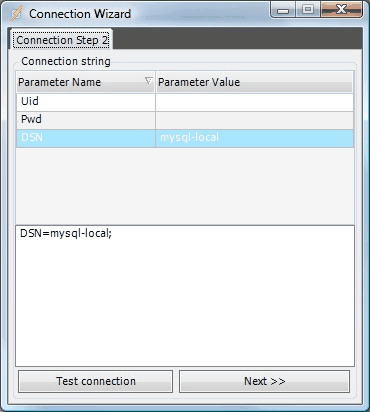
Edit the DSN parameters if needed before saving.
Use existing connection string
Manage Connections > Add > SQL > Guide 3 - Step 1

Enter the connection string.
Manage Connections > Add > SQL > Guide 3 - Step 2

Select the data provider (ODBC, OLEDB, Native MSSQL, Native MySQL, Native Oracle, etc.). For Oracle, the following connection string parameters are available:
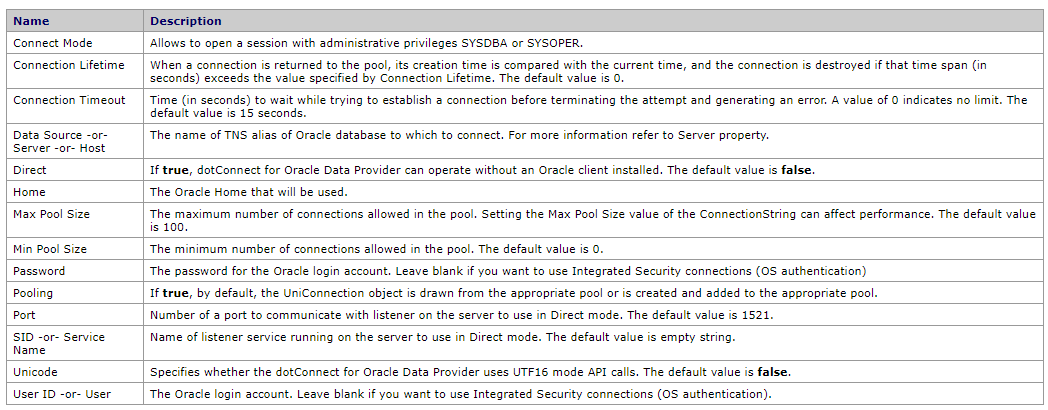
Manage Connections > Add > SQL > Guide 3 - Step 3

Enter the name of the Connection.
Convert data types
When checked and using stored procedures with OLEDB or ODBC, VisualCron will attempt to convert values to their specified data types. This is generally only needed for certain databases such as Sybase or SAP.
Troubleshooting
Error ORA-12514 when using Oracle Direct mode in Task
Make sure you are not using both SID and Service Name in the connection string. These cannot be used together — remove one of them.
Error ORA-28009 and "Keyword not supported: dba privilege"
Try using the Connect Mode parameter instead of DBA Privilege. For example: Connect Mode=SYSDBA