Connection - Sharepoint
The SharePoint Connection stores connect and logon properties for local SharePoint instances or the SharePoint online cloud service from Microsoft.
It is recommended for using On Prem server (Sharepoint 2016, etc), the "Sharepoint" connection.
It is recommended for using Sharepoint within the O365 environment, the "Sharepoint Online" connection.
Overall, the SharePoint Connection is used for the SharePoint Tasks:
- SharePoint - Create list
- SharePoint - Delete list(s)
- SharePoint - Describe list
- SharePoint - Get list(s)
- SharePoint - Update list
- SharePoint - Add list item
- SharePoint - Update list item
- SharePoint - Delete list item(s)
- SharePoint - Get list item(s)
- SharePoint - Upload file(s)
- SharePoint - Download file(s)
- SharePoint - List file(s)
- SharePoint - Delete file(s)
SharePoint Instance
Manage Connections > Add > SharePoint > Common settings tab
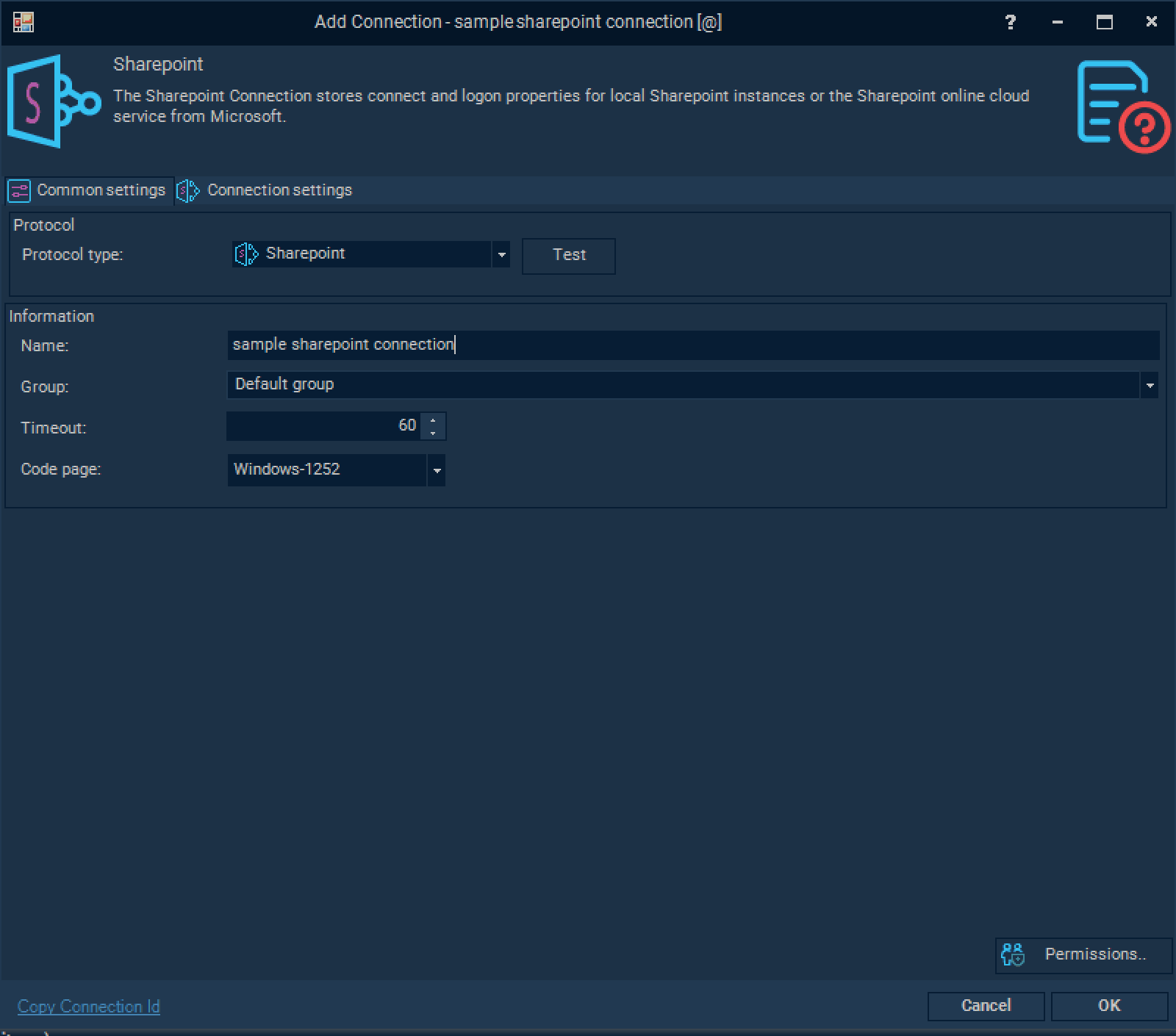
Name
The unique name for the Connection.
Group
Connection's group name.
Timeout
The connection timeout in seconds. Connection will fail after this time period.
Code page
Code page being used.
Manage Connections > Add > SharePoint > Connection settings tab
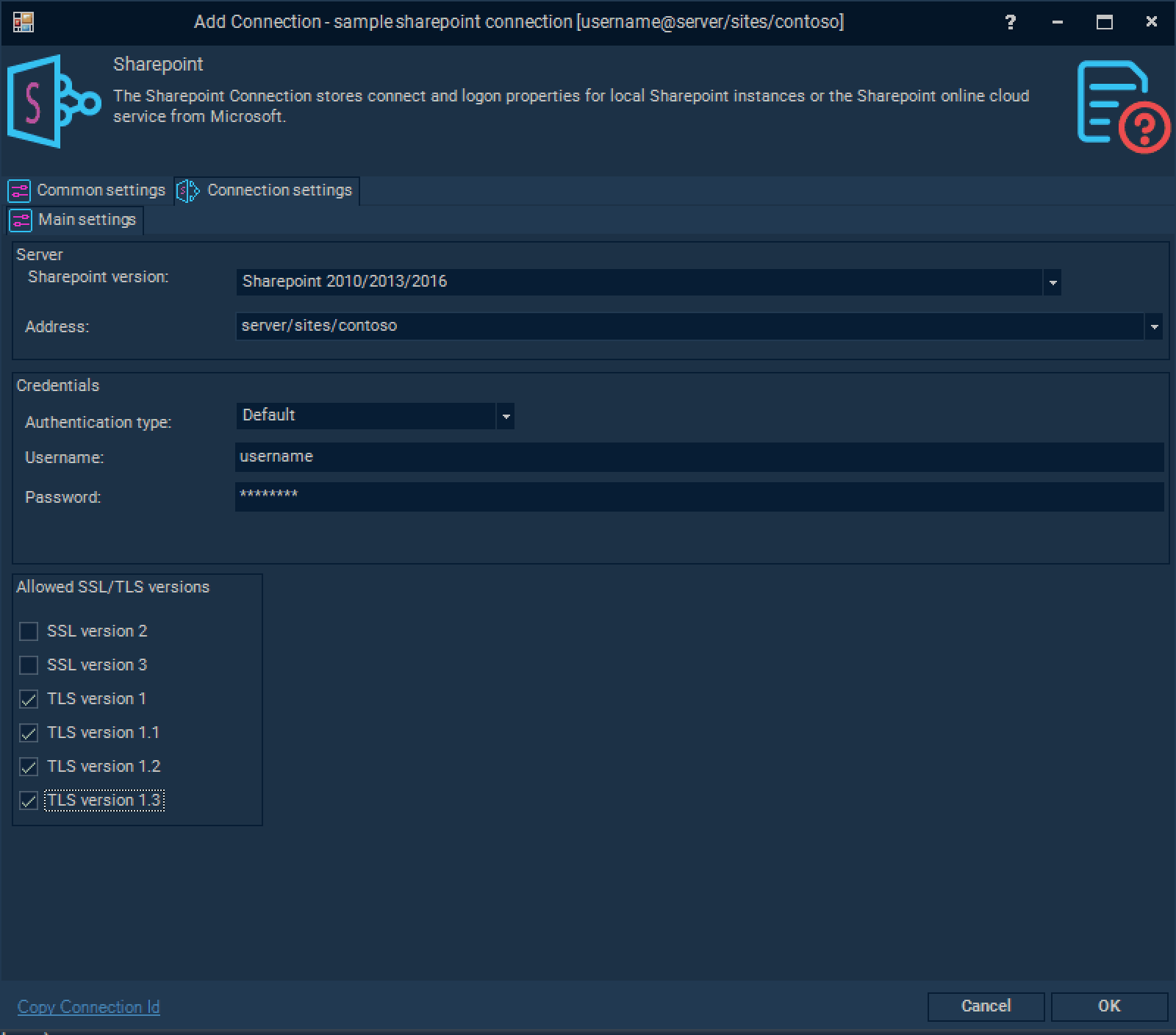
SharePoint version
Select between SharePoint Online or a local installation (SharePoint 2010/2013/2016).
Address
SharePoint site's address (either on-premises or online). For SharePoint Online, use
the site address from the SharePoint admin console — not the admin URL itself
(e.g. https://yourtenant.sharepoint.com/sites/yoursitename).
Authentication type
Select the type of authentication on the SharePoint server:
- Default — Windows authentication. Uses the running service account if the username matches; otherwise uses the supplied credentials.
- Basic — Standard username and password credentials.
- Form — Forms-based authentication using a username and password login form.
- Anonymous — No credentials required.
- ADFS — Active Directory Federation Services authentication. Requires username, password, and an STS URL (entered in the STS URL field).
- AppOnly — App-only client credentials using an Azure AD-registered application. The Username field is the Client Id and the Password field is the Client Secret. Requires a Tenant Id.
- Azure AD Application (Certificate) — Certificate-based Azure AD authentication. The Username field is the App ID. Requires a certificate and a Tenant Id.
Username
The username for the server. When using AppOnly, enter the Client Id. When using Azure AD Application (Certificate), enter the App ID.
Password
The password for the server. When using AppOnly, enter the Client Secret. Not used for Azure AD Application (Certificate).
STS URL
(ADFS authentication only) The URL to the ADFS Security Token Service endpoint.
Certificate
(Azure AD Application (Certificate) authentication only) Select a VisualCron certificate whose public key has been uploaded to the Azure AD application's certificate credentials.
Tenant Id
(AppOnly and Azure AD Application (Certificate) authentication only) The Azure AD Tenant ID (GUID) for your Microsoft 365 organization. Found in Microsoft Entra under the application's Overview page as Directory (tenant) ID.
SharePoint Online Instance
SharePoint Online (Protocol type: SharePoint Online) is a dedicated connection type
for Microsoft 365 cloud environments. It always authenticates via Azure AD OAuth.
To register a new application or use an existing one, log into Microsoft Entra and navigate to App registrations. You can create a new registration or select an existing app. From the application's Overview page, note the Application (client) ID (Client Id) and Directory (tenant) ID (Tenant Id) — these are entered into the VisualCron connection settings.
Manage Connections > Add > SharePoint Online > Common settings tab
Address
Use the site address from the SharePoint admin console — not the admin URL itself (e.g. https://yourtenant.sharepoint.com/sites/yoursitename).
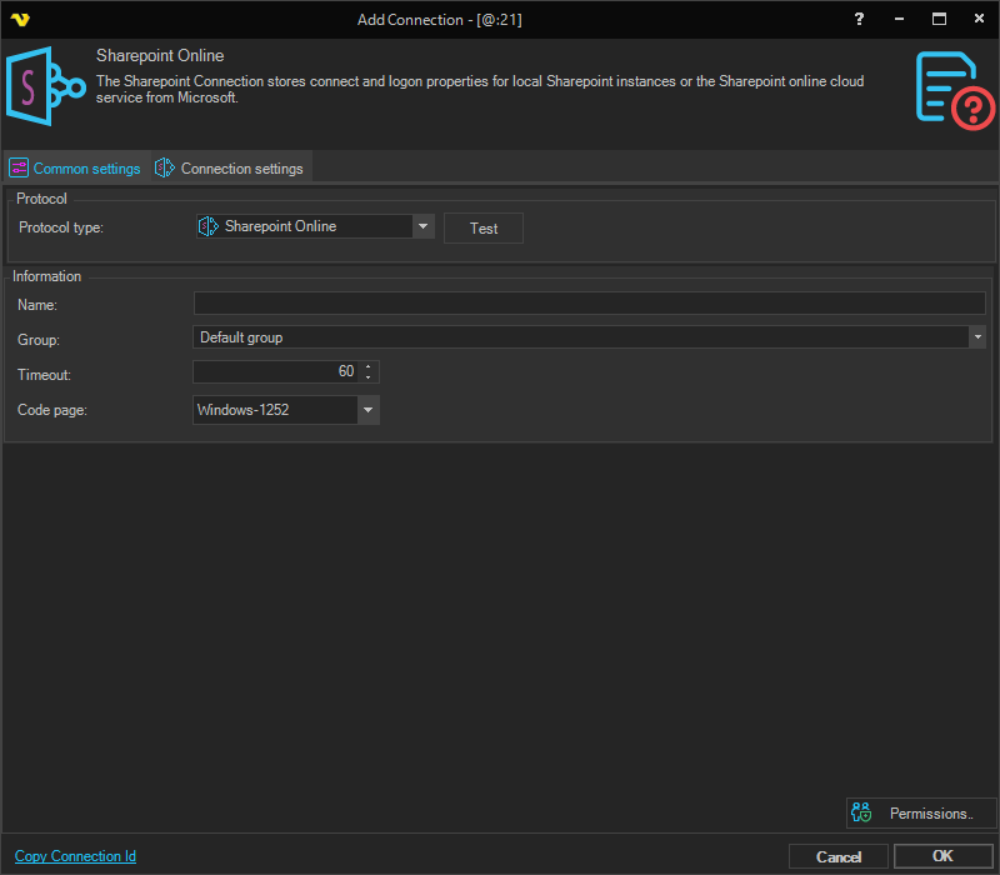
Select the appropriate authentication type from the Authentication type dropdown.
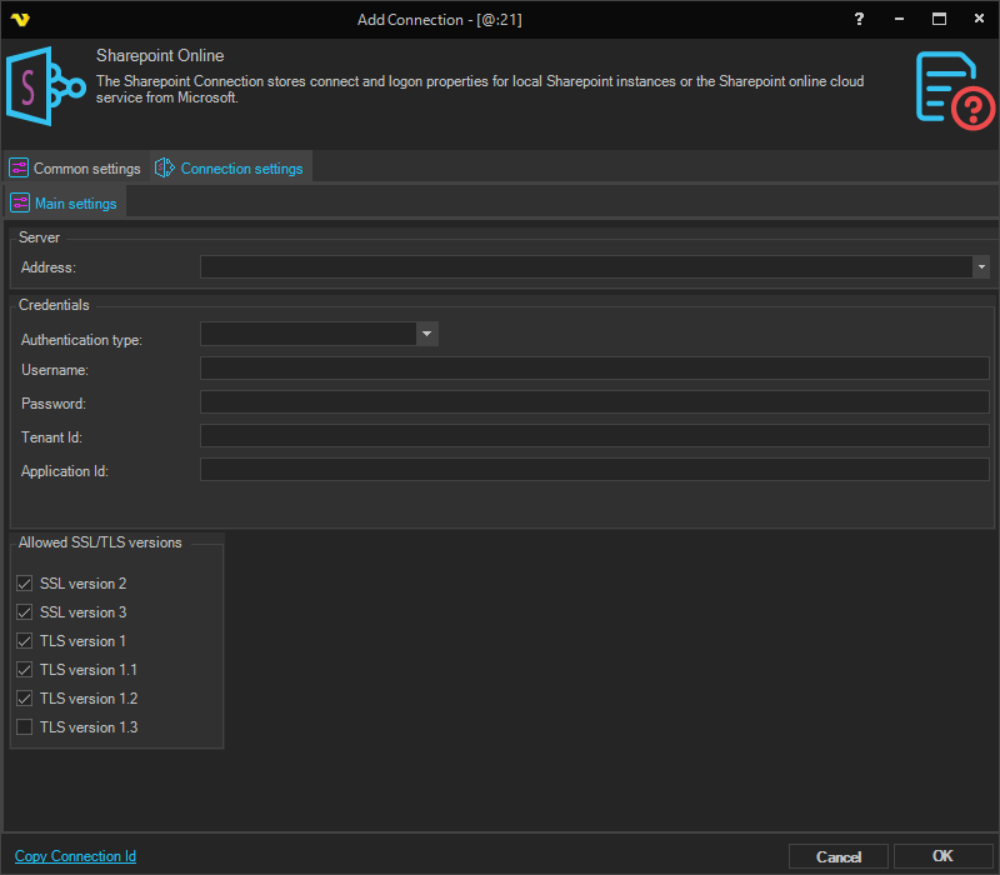
Basic Authentication — Deprecated Microsoft has permanently disabled Basic Authentication across its services, including Exchange Online, SharePoint Online, and Microsoft Graph. Any connection configured to use Basic Authentication will fail with an authorization error and cannot be restored. Basic Authentication is disabled at the Microsoft platform level and is not configurable by VisualCron or your system administrator. Affected connections must be reconfigured to use a supported authentication type.
AppOnly (Client credentials)
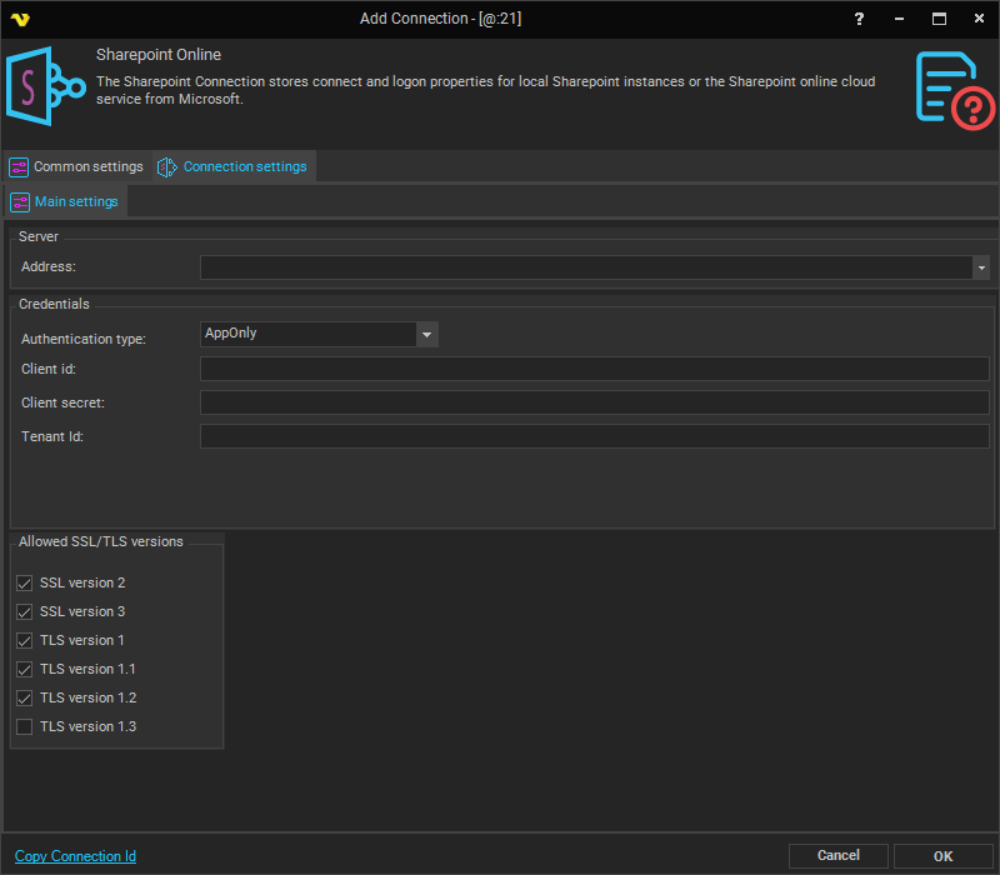
Username
The Client Id of the Azure AD app registration.
Password
The Client Secret of the Azure AD app registration.
Tenant Id
The Azure AD Tenant ID (GUID) for your Microsoft 365 organization.
Certificate
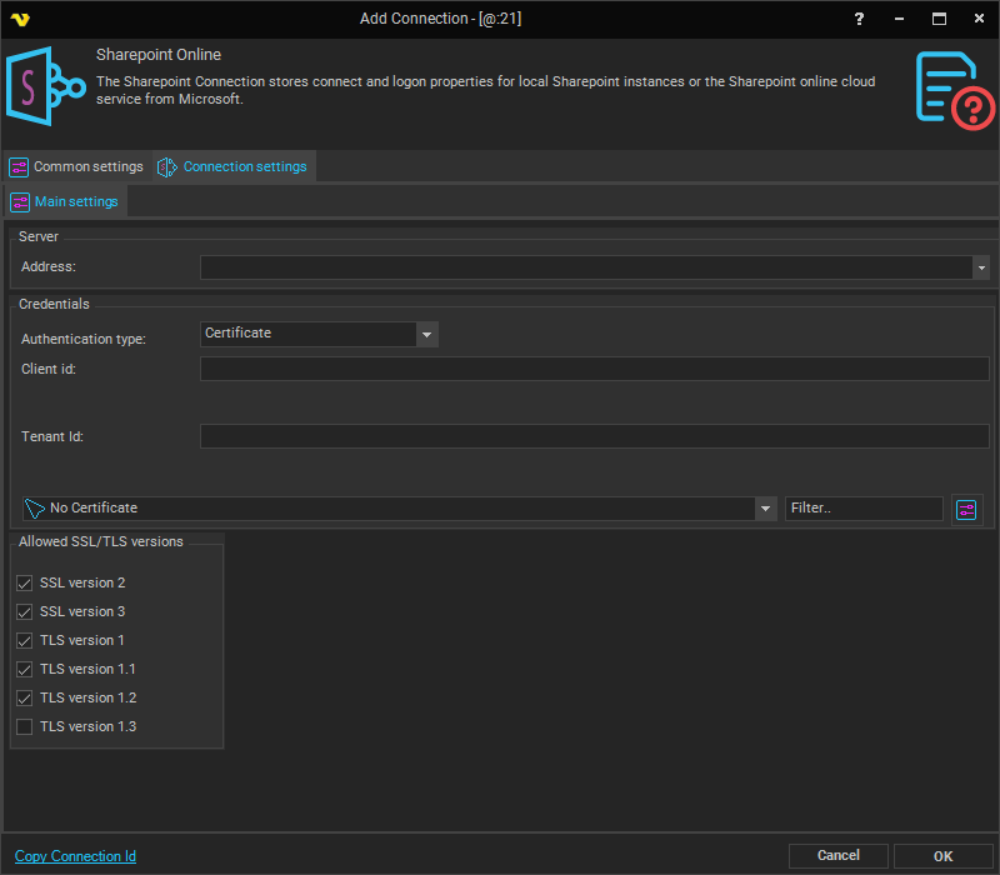
Client Id
The Application (Client) ID of the Azure AD app registration. Found in Microsoft Entra under the application's Overview page as Application (client) ID.
Tenant Id
The Azure AD Tenant ID (GUID) for your Microsoft 365 organization. Found in Microsoft Entra under the application's Overview page as Directory (tenant) ID.
Certificate
Select a VisualCron certificate whose public key (.cer file) has been uploaded to the Azure AD application's Certificates & Secrets.
You can use an existing or new Azure AD application to access your SharePoint Online sites. Please note that certificate-only credentials are accepted. Create an application on Azure AD and import the certificate to both the Azure AD application credentials and VisualCron. Only Certificate applications will be granted access to the SharePoint site; otherwise you will receive an HTTP 401 error.
The application should be given proper API permissions. An example of full permissions is provided below:

Setting up a Certificate for SharePoint Online
The following steps walk through creating a certificate, importing it into VisualCron, uploading it to Microsoft Entra, and configuring the connection.
Step 1 — Create the certificate
Open Windows PowerShell as Administrator and run the following to create a self-signed certificate:
$cert = New-SelfSignedCertificate `
  -Subject "CN=YourCertName" `
  -CertStoreLocation "Cert:\CurrentUser\My" `
  -KeyExportPolicy Exportable `
  -KeySpec Signature `
  -KeyLength 2048 `
  -NotAfter (Get-Date).AddYears(3) `
  -FriendlyName "YourCertName"
This script can be adapted to any environment — it is provided as a sample for testing purposes.
Step 2 — Export the certificate files
Run the following to export the certificate as a .pfx file (you will be prompted for a password):
Export-PfxCertificate -Cert $cert -FilePath "C:\Temp\MySPOApp.pfx" `
  -Password (Read-Host -AsSecureString "Enter password")
To export the public key as a .cer file:
Export-Certificate -Cert $cert -FilePath "C:\Temp\MySPOApp.cer"
Both files will be saved to the specified path (e.g. C:\Temp\).
Step 3 — Import the certificate into VisualCron
In the VisualCron client, navigate to Global Objects > Certificates > Import Certificate and select the .pfx file. VisualCron will prompt for the password set during export. Once entered, the certificate will appear in the VisualCron certificate list.
Step 4 — Collect Client ID and Tenant ID from Microsoft Entra
Log into Microsoft Entra, navigate to App registrations, and open your SharePoint application. From the Overview page, collect the following values:
- Application (client) ID — used as the Client Id in VisualCron
- Directory (tenant) ID — used as the Tenant Id in VisualCron
Step 5 — Upload the certificate to Microsoft Entra
In the same app registration, navigate to Certificates & Secrets > Certificates and click Upload certificate. Upload the .cer file created in Step 2.
Step 6 — Set API permissions
In the app registration, navigate to API Permissions and ensure the following SharePoint permissions are granted (Application type):
Sites.FullControl.AllSites.Manage.AllSites.Read.AllSites.ReadWrite.All
Grant admin consent for all required permissions.
Step 7 — Configure the connection in VisualCron
In the VisualCron client, open the SharePoint Online connection settings (Connection settings tab) and fill in:
- Address — The SharePoint site URL from the SharePoint admin console (e.g.
https://yourtenant.sharepoint.com/sites/yoursitename) - Authentication type — Certificate
- Client Id — The Application (client) ID from Step 4
- Tenant Id — The Directory (tenant) ID from Step 4
- Certificate — The certificate imported in Step 3
Click Test to verify the connection.
Setting up a Secret for Sharepoint Online
To generate a Client Secret, navigate within the Microsoft Tenant to Certificates & Secrets > Client secrets and click New client secret. Set a description and expiry, then click Add. Copy the secret Value immediately — it will not be shown again.
To set API permissions, navigate to API Permissions and add the following SharePoint Application permissions:
Sites.FullControl.AllSites.Manage.AllSites.Read.AllSites.ReadWrite.All
Click Grant admin consent to apply the permissions.
Troubleshooting and Sources
More information about AppOnly and Certificates can be found here(with PowerShell script sample for generating a certificate).
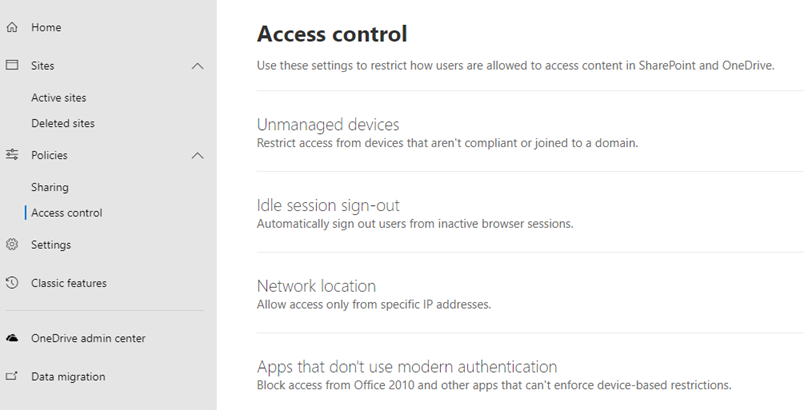
Cannot contact web site 'https://xxx.sharepoint.com/' or the web site does not support SharePoint Online credentials. The response status code is 'Unauthorized'
Allow access for Apps that don't use modern authentication.