Connection - SSH
The SSH Connection stores connect and logon properties for the Secure Shell (SSH) protocol. SSH provides a secure channel over an unsecured network in a client-server architecture, connecting a SSH client application with a SSH server. This connection allows you to connect and execute commands against Linux servers.
About SSH
Secure Shell (SSH) is a cryptographic network protocol for secure data communication, remote command-line login, remote command execution, and other secure network services between two networked computers that connects, via a secure channel over an insecure network, a server and a client (running SSH server and SSH client programs, respectively). The protocol specification distinguishes between two major versions that are referred to as SSH-1 and SSH-2.
The best-known application of the protocol is for access to shell accounts on Unix-like operating systems, but it can also be used in a similar fashion for accounts on Windows. It was designed as a replacement for Telnet and other insecure remote shell protocols such as the Berkeley rsh and rexec protocols, which send information, notably passwords, in plain text, rendering them susceptible to interception and disclosure using packet analysis. The encryption used by SSH is intended to provide confidentiality and integrity of data over an unsecured network, such as the Internet.
Manage Connections > Add > SSH - Secure Shell > Common settings tab
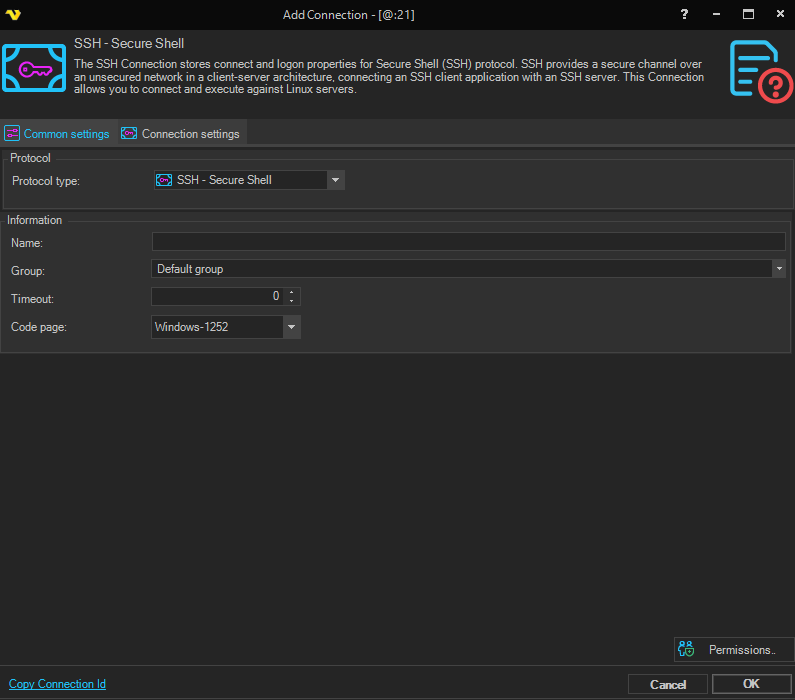
Name
The name of the Connection to uniquely identifying it.
Group
The group that the connection is a part of.
Timeout
The timeout setting in the SSH Connection refers to the max time the full connection is opened. Using a too low value may abort the command prematurely. Default is 0 which is infinite timeout which means it will finish when the command finishes (Command timeout in the Task).
Code page
Code page being used.
Manage Connections > Add > SSH - Secure Shell > Connection settings tab
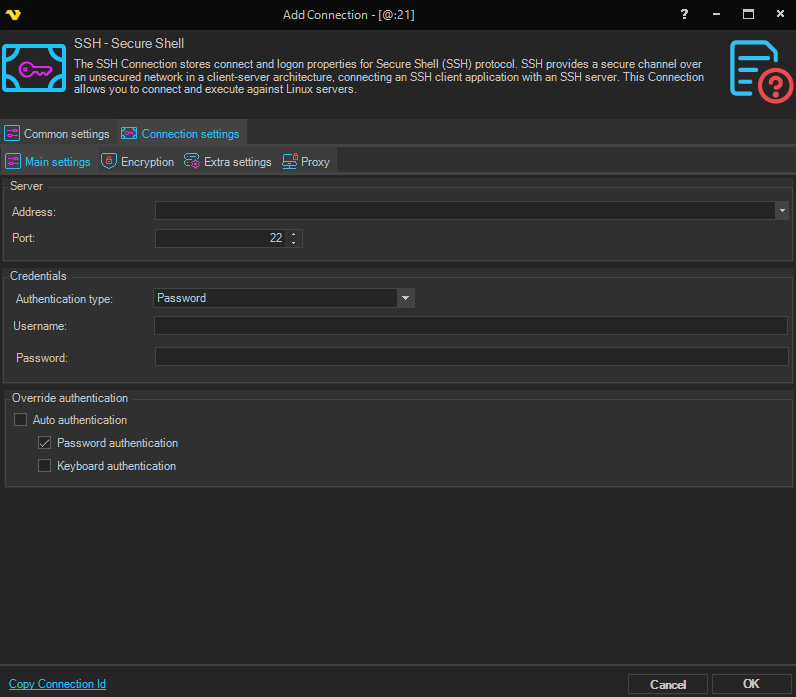
Address*
The host address of the server. This can be a DNS name or IP address.
Port
The remote connection port. Default is 22.
Authentication type
The method used to authenticate with the SSH server.
- Password - authenticate using a username and password
- Public key - authenticate using an SSH private key (password field is hidden and an SSH key selector is shown)
Username
User name for the SSH instance.
Password
The password for the SSH connection. Only visible when Authentication type is set to Password.
SSH key
The SSH private key used for authentication. Only visible when Authentication type is set to Public key.
Override Authentication
Options to override the default authentication behavior.
- Auto authentication - when enabled, the Password authentication and Keyboard authentication options are disabled and authentication is handled automatically
- Password authentication - enables password-based authentication (disabled when Auto authentication is checked)
- Keyboard authentication - enables keyboard-interactive authentication (disabled when Auto authentication is checked)
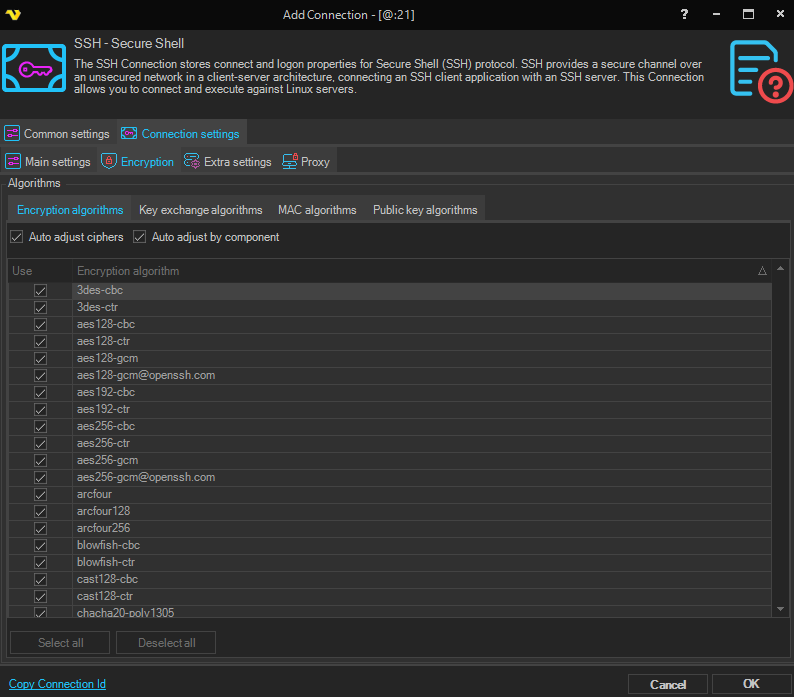
Manage Connections > Add > SSH - Secure Shell > Encryption tab
Cryptographic protocol
Select between No encryption, SSL or TLS.
Security mode
Select between Explicit or Implicit mode type.
Use data channel encryption (PROT P)
If this property value is True the channel used for data transfer (files, directory listings) will be encrypted, otherwise only command channel will be encrypted.
Use command channel encryption
If this property value is True the command channel will be encrypted.
Use SSL session resumption
Specifices if SSL session resumption should be used.
Manage Connections > Add > SSH - Secure Shell > Extra settings tab
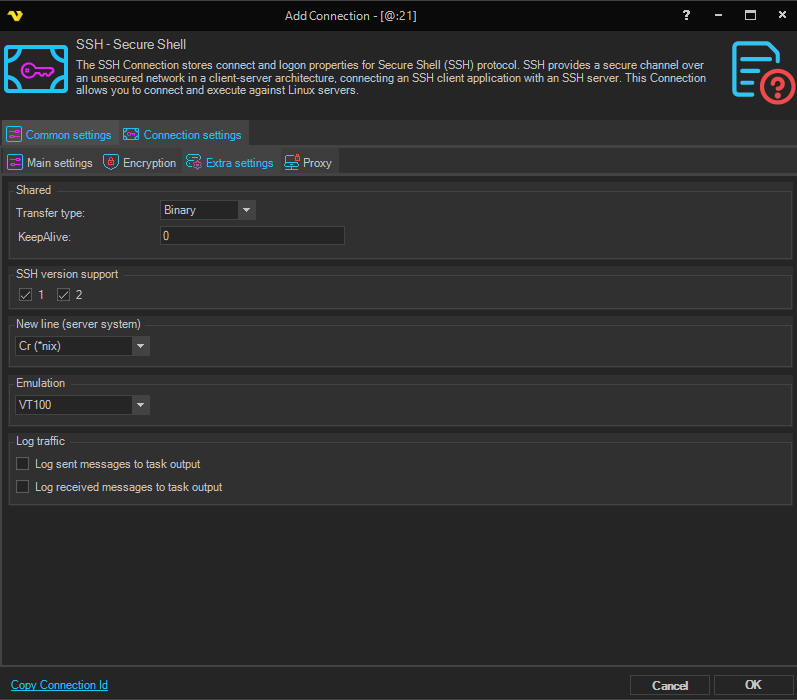
Transfer type
FTP/SFTP only. The method used to transfer data. Options are ASCII or Binary (default).
SSH version support
Checkboxes to select which SSH protocol versions are supported: 1 and/or 2.
New line (server system)
The newline character format used by the remote server.
- Cr (*nix) - carriage return, used on Unix/Linux systems
- CrLf (Windows) - carriage return + line feed, used on Windows systems
Emulation
The terminal emulation type to use for the SSH session.
Log sent messages to task output
When enabled, sent messages are logged to the task output.
Log received messages to task output
When enabled, received messages are logged to the task output.
Manage Connections > Add > SSH - Secure Shell > Proxy tab
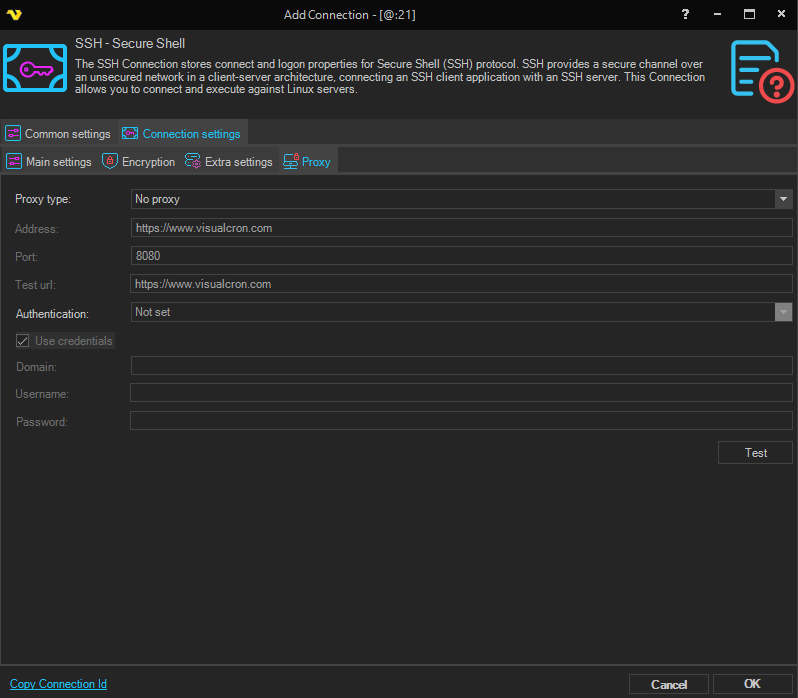
Proxy type
Select the proxy type to be used.
Address
The host name or IP address of the proxy server.
Port
The port of the proxy server.
Use credentials
The credentials that are associated with the account.
Domain
The name of the domain to be created.
Username
The user name to access the proxy server.
Password
The password to access the proxy server.
SFTP version support
SFTP only.
Troubleshooting
Other error codes
https://www.eldos.com/documentation/sbb/documentation/ref_err_ssherrorcodes.html