Task File - Archive - Compress
The Archive - compress Task compresses files into an archive in one of these formats: 7z, BZip2, GZip, Tar, Tar+GZip, Xz, Zip or Zipx.
The different formats provides different functionality and compatibility across different operating systems. The Tar and GZip formats can be used to read or write archives between Windows and Linux/Unix. The Zip format is the most versatile and the most common in Windows workstations. It allows you to encrypt your archive with a password and select a compression level.
Tar and GZip are usually used together. Tar is an archive; it gathers a collection of files or folders into a single file, while preserving file system information (such as permissions, dates and the folder structure). However, Tar does not compress the files in any way. The GZip format on the other hand is typically used to compress single files.
Using these two formats together, Tar to create an archive and then compressing it with GZip, can potentially attain greater compression ratios than using a compressing archiver such as ZIP. The ZIP format compresses the individual files and then archives them into a single .zip file. With a GZip Tar file, files are first archived into a .tar file and then the complete archive is compressed. The advantage is that the compression engine searches for similar patterns across the entire archive, rather than just within each individual file, thereby increasing the chances of finding the patterns for this kind of compression. When used together, the resulting files typically have a .tar.gz extension. For the Tar+GZip format in this Task, end the archive path in ".tar.gz".
By default, the maximum path length limit in Windows is 260 characters. However, it is possible to remove the limitation on Windows 10 (v. 1607 or later) so that VisualCron will support the paths that are longer than 260 characters. In the context of the current Task, this feature allows to archive files within folders of unlimited depth, ensuring correct extraction at any nesting level of the target folder. To turn this on, see Enable long paths in Windows.
When the Archive - compress Task is selected in the Task window you are presented with a set of sub tabs within the Archive - compress tab.
Archive - compress > Archive settings sub tab
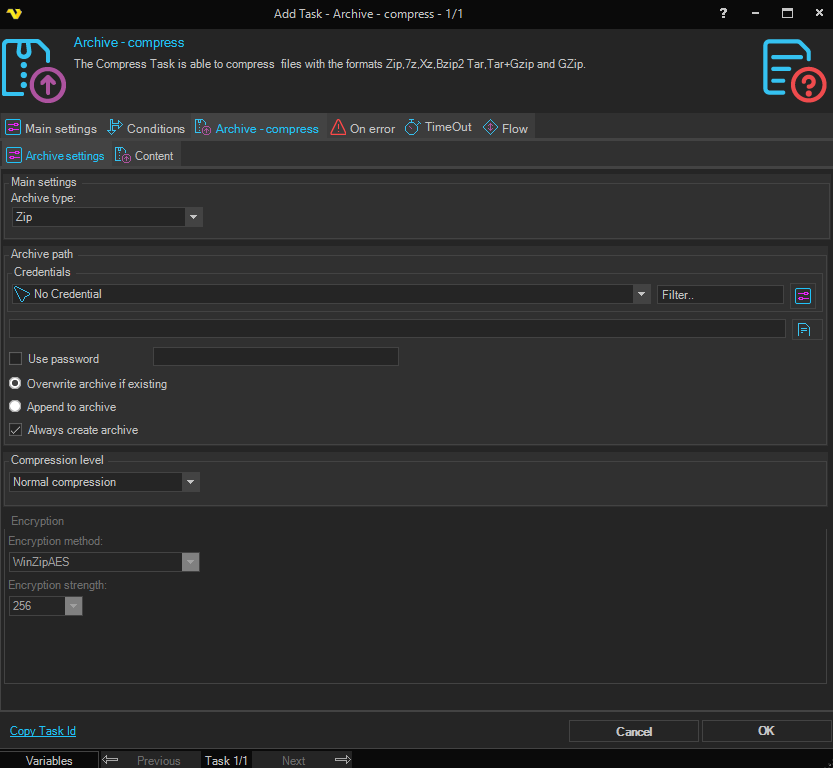
The archive settings sub tab controls the main settings, including the archive format and what happens when the archive already exists.
Archive type
Select one of 7z, BZip2, GZip, Tar, Tar+GZip, Xz, Zip and Zipx.
Credential
Optional Credential for accessing the archive path when it is on a remote or network location.
Archive path
The archive path is the full path where your archive is stored. You can choose any name for your archive but the following names are recommended:
- 7z:
"myarchive.7z" - Zip:
"myarchive.zip" - Zipx:
"myarchive.zipx" - Tar:
"myarchive.tar" - Tar+GZip:
"myarchive.tar.gz" - GZip:
"myarchive.gz" - BZip2:
"myarchive.bz2" - Xz:
"myarchive.xz"
Use password
Available for the 7z, Zip and Zipx formats. Enter the password that protects the archive.
Compression level
Available for the 7z, Zip and Zipx formats. A higher level is slower and produces a smaller file. Levels: Ultra compression, High compression, Normal compression (default) and Low compression.
Encryption method
Available for 7z, Zip and Zipx archives when Use password is selected. For Zip and Zipx archives:
- WinZipAES (default): AES encryption. Use it unless the recipient's software cannot open AES archives
- Compatible: traditional Zip encryption, which is weak; use it only for compatibility
Encryption strength
Available when Encryption method is WinZipAES. Select 128, 192 or 256 bits (default 256). Use 256 unless the recipient cannot open it.
Overwrite archive if existing
When this option is selected, the archive will be overwritten (if existing).
Append to archive
If the archive exists it will be appended with new items.
Always create archive
When checked, an empty archive file is created even if no files match the content filter. When unchecked, no archive is written if there are no matching files.
Archive - compress > Content sub tab
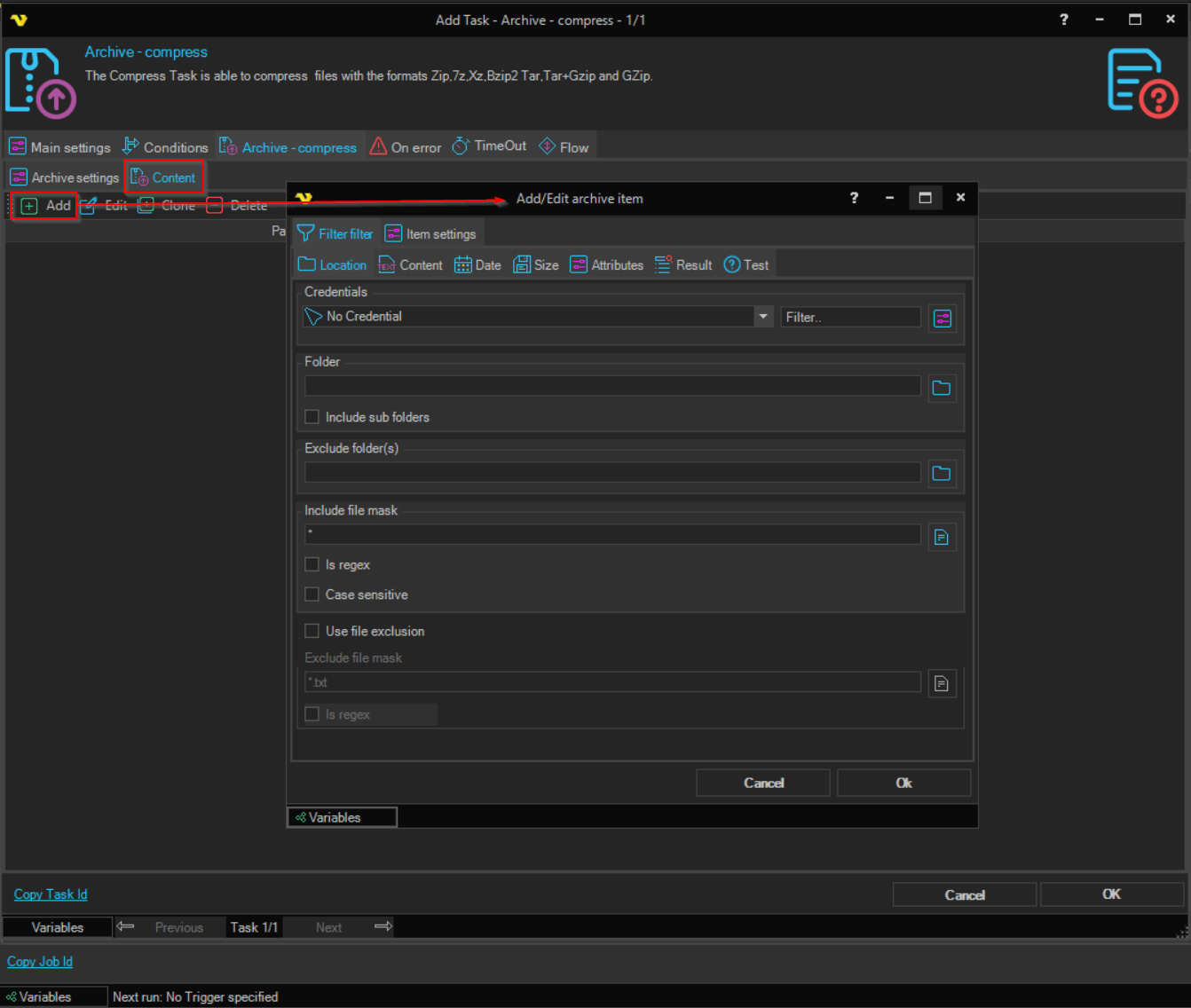
This sub tab contains a list of items/objects to be compressed. Use the Add, Edit, Clone, and Delete toolbar buttons to manage items.
The Archive item dialog uses the standard file filter to select which files to add to the archive.
Archive item > Item settings tab
These settings decide what happens to the archive's existing contents when the archive already exists: because Append to archive is selected on the Archive settings sub tab, or because an earlier item in this Task has already added files to it.
- Overwrite if existing (default): entries already in the archive that match the files this item adds are removed, and then the item's files are added
- Append to archive: the item's files are added, and no existing entry is removed first
These settings are not used for the Tar+GZip format.
Delete source file after
When checked, the source file is deleted after it has been successfully added to the archive.
When you are accessing a network drive (a folder on a remote computer) as source or destination folder you must specify the path in UNC format and not the letter of the logical drive. For example Y:\remotefolder\ must be specified as \\remoteservername\remotefolder\.
Enable long paths in Windows
This changes a Windows setting for the whole computer, not only for VisualCron.
To enable long paths by using the registry (Windows Home), complete the following steps:
- Press the Windows key and R together. The Run dialog opens.
- In the Open field, enter
"regedit". - Select the OK button. The Registry Editor window opens.
- Go to
"HKEY_LOCAL_MACHINE\SYSTEM\CurrentControlSet\Control\FileSystem". - Create a DWORD (32-bit) value named
"LongPathsEnabled". - Set the value of
"LongPathsEnabled"to"1". - Restart the computer.
After the restart, Windows accepts paths longer than 260 characters.
To enable long paths by using Group Policy (Windows Pro and Enterprise, and Windows Server 2016 or later), complete the following steps:
- Press the Windows key and R together. The Run dialog opens.
- In the Open field, enter
"gpedit.msc". - Select the OK button. The Local Group Policy Editor window opens.
- Go to Local Computer Policy -> Computer Configuration -> Administrative Templates -> System -> Filesystem.
- Open the Enable Win32 long paths setting.
- Select the Enabled option.
- Select the OK button.
- Restart the computer.
After the restart, Windows accepts paths longer than 260 characters.