Task Net - TCP
The TCP Task connects to a TCP server (listener) as a client and exchanges plain-text messages with it, following a tree of messaging rules: what to send, what to wait for, and what to check in a reply.
This Task uses a TCP Connection; see Connection - TCP. In the Connection, enter only a host name or an IPv4 address in Address: the Client splits the text at each ":", "/" or "\" and keeps one part, so an IPv6 address, a port or a path there does not work.
The messages are sent and received as plain text, without encryption, so anyone who can see the network traffic can read them.
The Main settings, Flow, On error, Conditions and TimeOut tabs are the same for every Task; see Job - Tasks.
Interaction rules tab
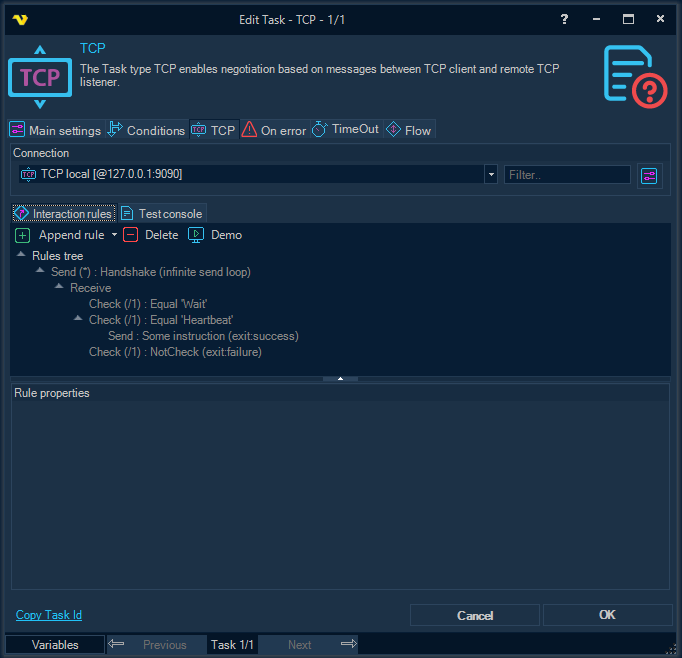
Select the TCP Connection with the server's address and port in the Connection group.
The tab holds the tree of rules that controls the exchange (see TCP messaging rules). The toolbar has these commands:
-
Append rule: adds a child rule to the selected rule: "Send", "Receive" or "Check"
-
Delete: deletes the selected rule and all its child rules
-
Demo: replaces the current rules with an example of a simple exchange between a client and a server
If the tree has rules, the Client asks before it deletes them.
TCP messaging rules
Messaging rules set up the exchange between the TCP server (listener) and the TCP client. The TCP Task and the Event Trigger - TCP use the same rules. The only difference is Fire trigger, which only the Trigger uses.
There are three types of rule:
- Send: sends a message
- Receive: waits for a message
- Check: checks the message of its parent rule
The rules form a tree, so that the exchange can take different paths depending on the content of a message. The rules at one level run in order. A rule runs its child rules before the next rule at its own level. Select a rule to set its properties in Rule properties.

The Base subtab, for every rule:
-
Custom rule name: optional, stored encrypted
Without a name, the rule gets a generated name.
-
Result message key: optional. When it is set, the message of the rule is added to the result list under this key
For each key, only the last message is kept.
-
Use key as format string: uses Result message key as a number format for a message counter, so that each message gets its own key
For example, "D2" gives the keys "01", "02" and so on.
-
Fire trigger: TCP Trigger only. Fires the Trigger with the current message, and then clears the result list
-
Force exit: whether the exchange stops and the connection closes after this rule and its child rules:
- blank (default): no forced exit; the exchange continues
- "Success": ends the exchange as successful
- "Failure": ends the exchange with an error, so the Task fails
Force exit is useful to end rules that repeat without limit.

The Send subtab:
-
Number of iterations: how many times the rule and its child rules run before the next rule at the same level
"1" by default. "0" skips the rule, and "-1" repeats it without limit.
-
Text body: the message to send, stored encrypted. It can contain Variables
-
Delay before send: optional wait before the message is sent, in milliseconds
-
Delay after send: optional wait after the message is sent, in milliseconds

The Receive subtab:
-
Number of iterations: as on Send
-
Receive timeout: how long, in seconds, to wait for a message
"-1" (default) uses the Timeout of the TCP Connection, or "30" seconds when that is "0". "0" waits for a message without a time limit. If the server closes the connection before a message arrives, the rule fails.

The Check subtab:
-
Exclusive group index: optional. Groups Check rules that are children of the same rule
Check rules that are children of the same rule and have the same index other than "0" form a group: once one of them matches, the others are skipped.
-
Match condition: how the message of the parent rule is compared with Match value
The values are "Don't check" (default; always matches), "Equal (=)", "Contains (=%)", "Not contains (!=%)", "Not equal (!=)", "Regex - match" and "Regex - no match". The comparisons are case sensitive.
-
Match value: the value to compare with, stored encrypted. It can contain Variables
When a Check rule does not match, its child rules are skipped, and the Task still succeeds. A reply that matches no Check therefore does not make the Task fail. To fail on an unexpected reply, add a Check that matches it, with Force exit set to "Failure".
Test console tab
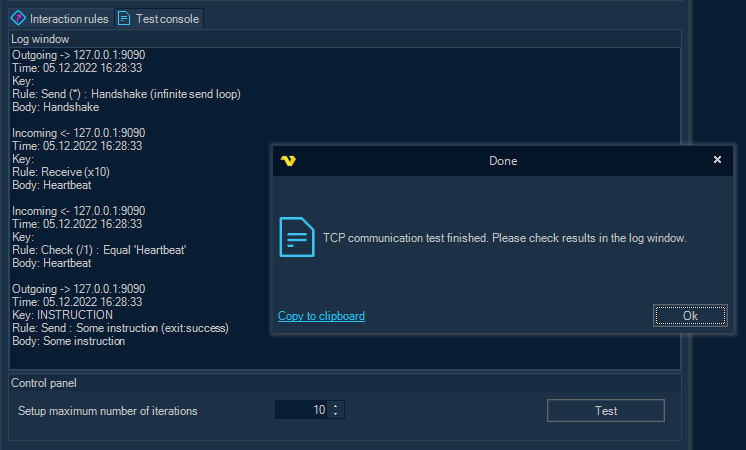
Use the Test console tab to try the rules without saving the Task. The test runs on the VisualCron Server with the selected Connection, and the messages are shown in the Log window. As the server side of the test, you can run a similar test in the Event Trigger - TCP window, or build and run the sample listener below.
-
Setup maximum number of iterations: for the test only, rules with more iterations, or with "-1", run at most this many times
The default is "10", from "1" to "999".
-
Test: runs the test
The limit applies only to the test. When the Task runs, a rule with "-1" iterations repeats until a rule with Force exit ends the exchange, the connection closes, or the Task times out (see Task - Timeout).
Output and result
Only the messages of rules with a Result message key are written to the output of the Task, and only when the TCP Connection has Log sent messages to task output or Log received messages to task output selected. A rule without a key is not logged.
The Task has one result Variable:
- Messages: the list of result messages, as
{ Key, TextBody }pairs, so that a Variable can read the text of a message by its Result message key
Sample TCP listener (C#)
using System.Net;
using System.Net.Sockets;
using System.Text;

namespace TCP_Listener
{
  internal class Program
   {
      static void Main()
       {
           TcpListener tcpListener = null;
          try
           {
              /*
                * Start listening
                */
               Console.WriteLine("Starting listener .....");
               tcpListener = new TcpListener(new IPEndPoint(IPAddress.Parse("127.0.0.1"), 9090));
               tcpListener.Start();
               Console.WriteLine("Listener started");

              /*
                * Wait for TCP client
                */
               Console.WriteLine("Waiting for connection .....");
              using var tcpclnt = tcpListener.AcceptTcpClient();
              using var stm = tcpclnt.GetStream();
               Console.WriteLine("Client connected");

              /*
                * WARNING:
                *   the encoding should be the same as configured in the TCP Connection / Common settings / Code page
                */
              var enc = Encoding.UTF8;
              string message;
              byte[] buffer;

              /*
                * Receiving an initial handshake message
                */
               Console.WriteLine();
               Console.WriteLine("Receiving an initial message .....");
               Thread.Sleep(1000);

               buffer = new byte[tcpclnt.ReceiveBufferSize];
              var cnt = stm.Read(buffer, 0, buffer.Length);

               message = enc.GetString(buffer, 0, cnt);
               Console.WriteLine("Message received : " + message);

              /*
                * Checking the handshake message
                */
              const string handshake_request = "Handshake";
              if (message == handshake_request)
               {
                   Console.WriteLine("Handshake request checked.");
                   Thread.Sleep(1000);
               }
              else
               {
                   Console.WriteLine($"The request is invalid. Must be '{handshake_request}'");
                  return;
               }

              /*
                * Sending "Heartbeat"
                */
               message = "Heartbeat";
               Console.WriteLine();
               Console.WriteLine($"Sending '{message}' .....");
               buffer = enc.GetBytes(message);
               stm.Write(buffer, 0, buffer.Length);

               Console.WriteLine($"'{message}' sent");
               Thread.Sleep(1000);

              /*
                * Receiving some instruction
                */
               Console.WriteLine();
               Console.WriteLine("Receiving an instruction .....");
               buffer = new byte[tcpclnt.ReceiveBufferSize];
               cnt = stm.Read(buffer, 0, buffer.Length);

               message = enc.GetString(buffer, 0, cnt);
               Console.WriteLine("Instruction received : " + message);
           }
          finally
           {
               tcpListener?.Stop();
               Console.WriteLine("Exit.");
           }
       }
   }
}