Task Net - Web Macro
The Web Macro Task records actions in a built-in browser and plays them back later, in the background, at any time.
The Main settings, Flow, On error, Conditions and TimeOut tabs are the same for every Task; see Job - Tasks.
Features of the Web Macro Task:
- Playback uses a browser based on the Chromium engine, for speed and compatibility
- Plugins are supported; see the Plugins tab below
- Playback runs in the VisualCron Server service and needs no interaction, so no one has to be logged on
- Several web macros can run at the same time, and you can keep working on the computer during playback
- Passwords and keys entered in the Task, such as the Google API key, the Google Client secret and the proxy password, are stored encrypted; cookies kept with Store cookies are not (see Store cookies below)
- File filters, Variables and stored Credentials can supply values at run time, such as dates
- The Task can handle several browser tabs at the same time, and copy and paste data between them
- Popup windows open in a new tab
- Files can be uploaded and downloaded, and file filters can select the files to upload
- The proxy can be changed at any point in the macro
- Client certificates can be imported, and are presented when a server asks for one
- Tabs can be opened in Incognito mode
- Pages can be printed and saved as screenshots
- You can set the User-Agent, the HTTP referer and the Accept-Language that the browser sends
- JavaScript can be injected into a page
- Google API keys can be set, for Google features such as speech recognition
- You control the playback speed, from typing text to the wait before and after each action
Web macro: Main settings tab
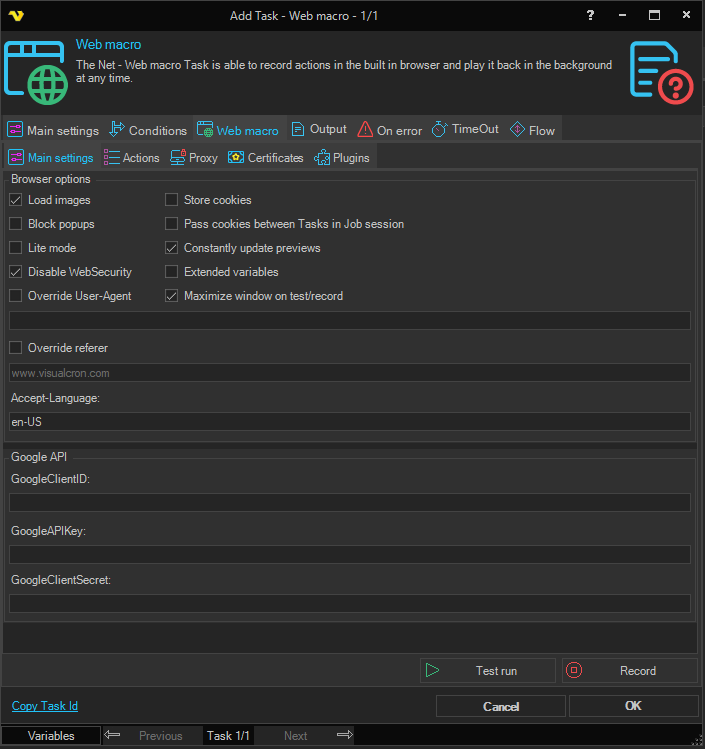
The Web Macro settings have their own tabs inside the Task window: Main settings, Actions, Proxy, Certificates and Plugins. This Main settings tab is not the Task window's shared Main settings tab.
The Browser options group holds the following settings:
-
Load images: selected by default; clearing it makes pages load faster, but keep it selected if the macro depends on images
-
Block popups: when cleared, a popup that a page opens in a new window opens in a new tab instead; select it to stop this
-
Lite mode: turns off rectangle selection and other JavaScript-intensive actions while recording
-
Disable WebSecurity: selected by default; see the warning below
-
Override User-Agent: when selected, the browser sends the User-Agent in the text field instead of the one for its own Chromium version
-
Store cookies: when selected, the Task keeps the cookies from one recording and uses them in the next; see the warning below
This helps when a site asks security questions the first time you log on: select Store cookies, record once while answering the questions, then record again. The cookies from the first recording are still present. When you clear Store cookies and save the Task, the stored cookies are deleted.
-
Pass cookies between Tasks in Job session: shares cookies with the other HTTP and Web Macro Tasks of the same Job run, to keep sessions open
When this Task succeeds, it adds its cookies to the cookie store of the Job run. Later HTTP Tasks in the same run send them, and later Web Macro Tasks use them if they also have this setting selected. With this setting selected, the Task also receives the cookies that earlier HTTP and Web Macro Tasks of the run left in the store. For the HTTP Task, see Task Net - HTTP.
-
Constantly update previews: selected by default; when selected, the action preview images are updated after a recording or test run
-
Extended variables: cleared by default; when selected, the Job Variables and User Variables are loaded into the action designer on the Actions tab
-
Maximize window on test/record: selected by default; when selected, the recorder window opens maximized when you click Record or Test run
-
Override referer: when selected, the browser sends the referer in the text field instead of the last page visited; the field holds a sample value until you change it
-
Accept-Language: the Accept-Language that the browser sends, "en-US" by default
Some sites return different content for different languages, for example in date and time formats or in the page language.
Disable WebSecurity is selected by default. While it is selected, the browser does not enforce the same-origin policy, so a page in the Task's browser can read data from other sites that the same session is signed in to. Clear it unless playback fails without it; see Troubleshooting.
With Store cookies selected, the site's cookies, including session and logon cookies, are saved with the Task as text. Unlike passwords, they are not encrypted, so anyone who can read or export the Task can reuse the session. Clear Store cookies when the macro no longer needs it.
The Google API group holds the Google keys. Some browser features rely on Google APIs. For example, location relies on Google's geolocation API, and speech recognition relies on Google's Speech API. To use these features, get Google API keys and enter them in this group:
- GoogleClientID: your Google Client ID
- GoogleAPIKey: your Google API key, stored encrypted
- GoogleClientSecret: your Google Client secret, stored encrypted
To get a Google API key, complete the following steps. Google changes its console often, so the labels can differ.
- Go to
https://console.developers.google.com/. - Sign in with a Google account.
- Create a project, or select an existing one.
- Enable the API that the feature needs, for example the Speech API.
- Open Credentials.
- Create an API key.
The new key appears in the console. Enter it in GoogleAPIKey.
Recording a web macro
Click Record to start recording. The Web recorder window opens; see Web recorder window.
Playing back a web macro
A web macro can be played back in both the Client and the Server. Click Test run to play it back in the Client.
Test run runs the actions on the computer running the Client. Files are then found and saved on that computer, and Credentials are applied there. When the Task runs from a Job, the Server does this instead. A folder, file or Credential that works in a test run can therefore fail when the Task runs on the Server, or the reverse.
Web macro: Actions tab
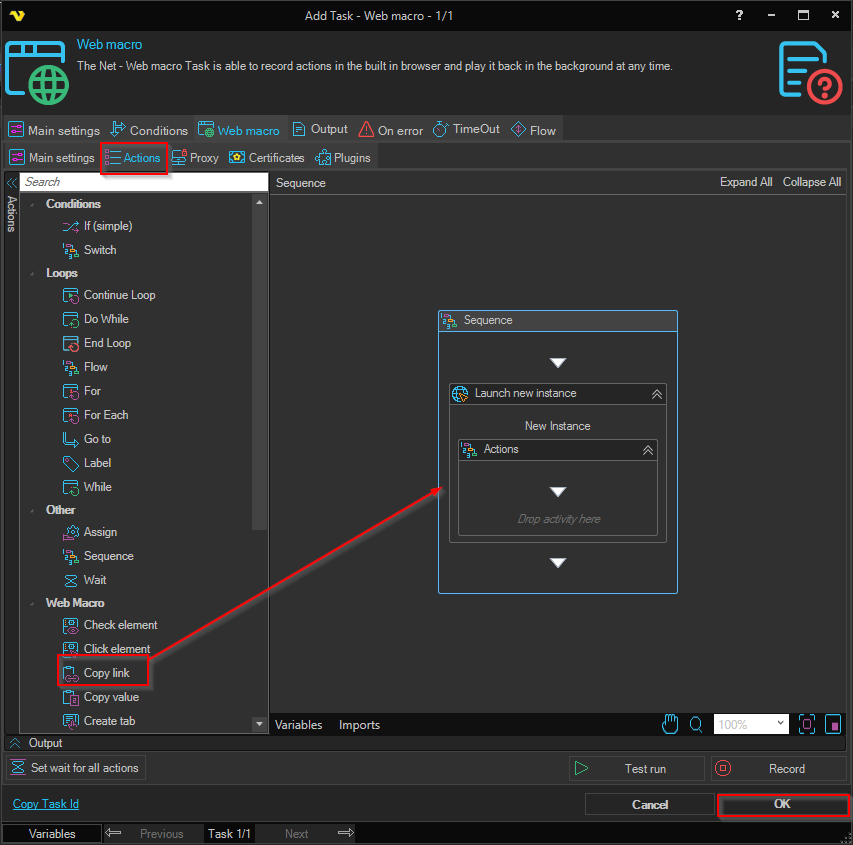
The Actions tab shows the Task's actions in a workflow designer. Actions are created automatically while you record. You can also add some actions manually in the Web recorder window; see Web recorder window.
If the workflow has errors, an errors panel opens on the tab. Until the errors are fixed, the Task cannot be saved and Test run is unavailable.
Each action waits before it runs and after it runs, in milliseconds (Wait before execute and Wait after execute, "500" each by default). To set both values on every action at once, click Set wait for all actions. The button shows only on the Actions tab.
Web macro: Proxy tab
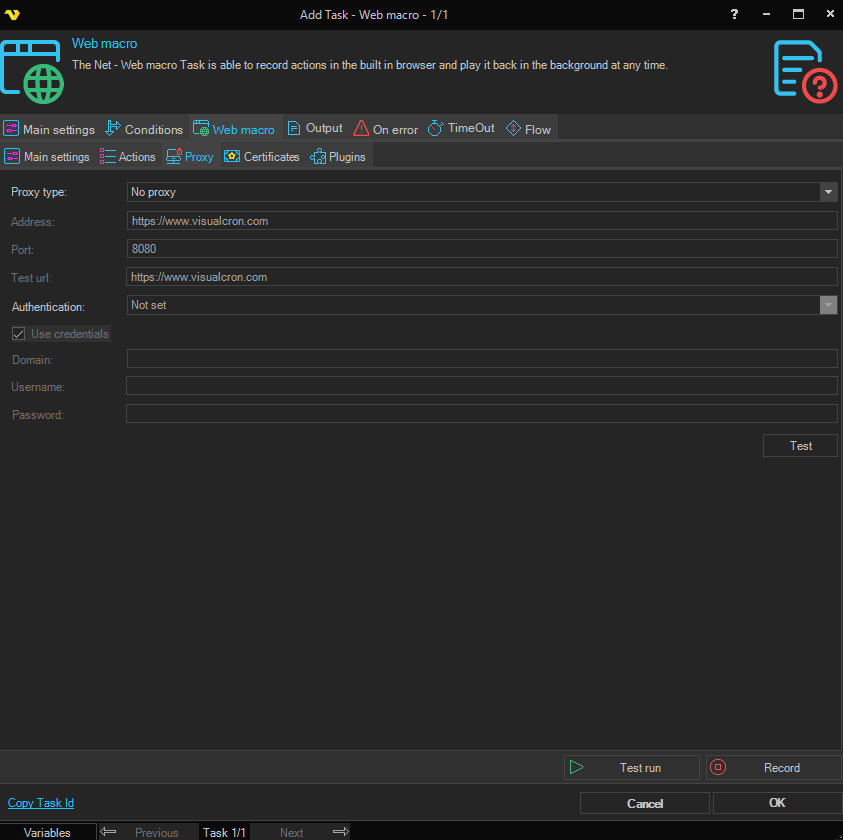
The Proxy tab sets the default proxy for all browser tabs. To change the proxy part way through the macro, add a Proxy action; see Proxy Step. The proxy fields are the same as on the Proxy action, except Reload the current page after proxy change, which only the action has.
When Proxy type is not "No proxy", Address and Port are required, and Port must be a whole number. With Use credentials selected, Username and Password are also required. These fields are checked when you save the Task and when you click Record or Test run.
Web macro: Certificates tab
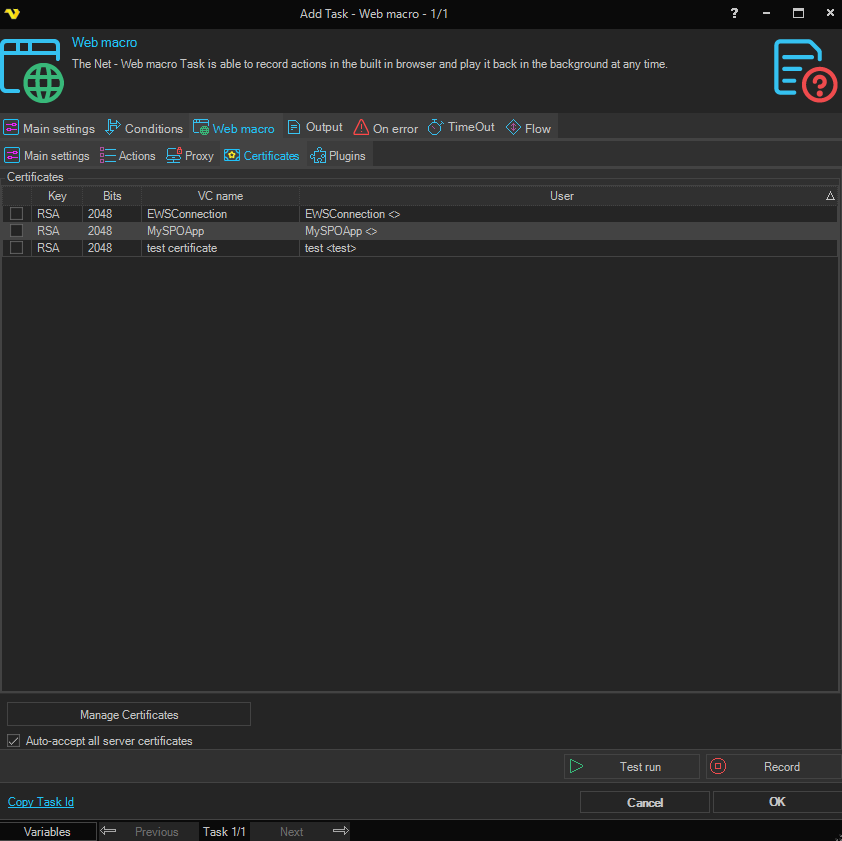
The Web Macro Task can present a client certificate to a remote server when the server asks for one. Client certificates are managed globally; see Global - Certificates. To open the global list, click Manage Certificates. In the Certificates list, select Use for the certificate to present. One certificate can be used at a time.
If the selected certificate is later removed from the global certificates, the Task fails when it runs.
Auto-accept all server certificates has no effect: the Task always runs with server certificates auto-accepted, whether or not the box is selected. Use the Task only with sites you trust, and do not rely on it to detect an invalid or replaced server certificate.
Web macro: Plugins tab
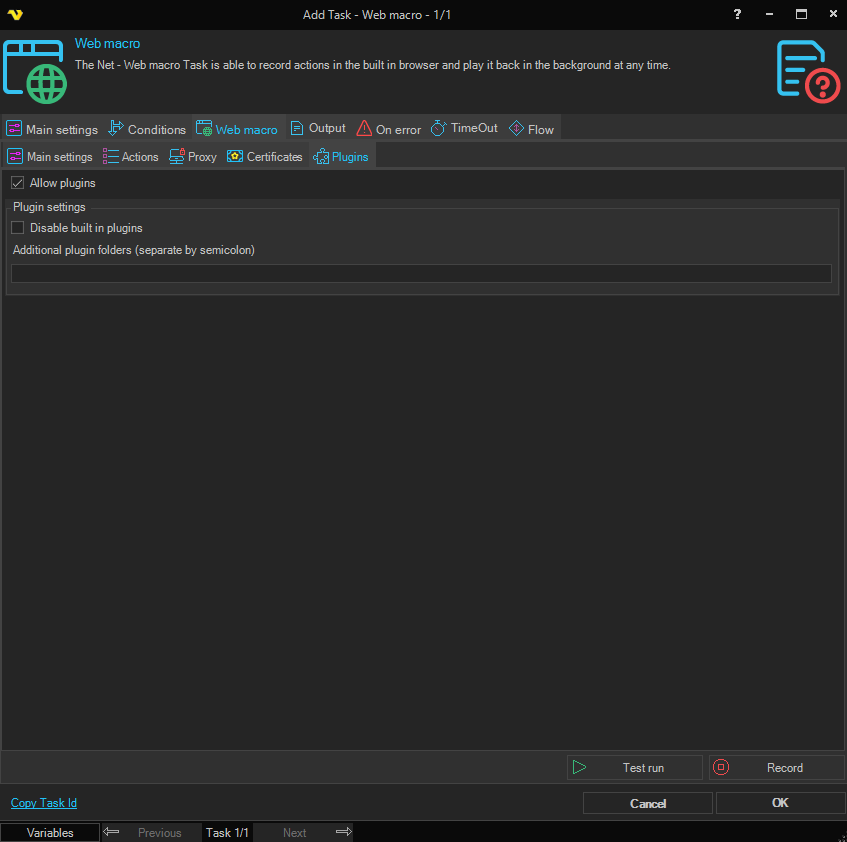
The Web Macro browser does not support NPAPI plugins.
The Web Macro browser (Chromium based) does not support Flash, which reached end of life in 2020.
- Allow plugins: selected by default; when selected, plugins are enabled and the Plugin settings group becomes active, and when cleared, all plugin support is off
The Plugin settings group holds the following settings:
- Disable built in plugins: cleared by default; when selected, the built-in PDF plugin is not loaded
- Additional plugin folders (separate by semicolon): the folders of plugins that are located elsewhere, separated by semicolons
Output tab
The Task window adds an Output tab for this Task type. It is not one of the Web macro tabs above. It controls the recording of the playback that the Task adds to its output, which the Server builds from the screenshots taken during playback. To view the output of a run, see Task - Output and Result.
The Output settings group holds the following settings:
- Output type: "None", "Images", "GIF" (default) or "Video"; "None" turns off all other settings on the tab
- Frame rate: frames per second, from "1" to "60", "1" by default; not used with "Images"
- Quality: from "1" to "100", "75" by default; used only with "Images" when Image format is "JPEG"
- Image format: "BMP", "JPEG", "GIF", "PNG" (default) or "TIFF"; used only with "Images"
- Open settings: opens the video compression settings; used only with "Video"
- Save output to file: cleared by default; when selected, the output is also saved to a file, set in the File output settings group, and when cleared, it is kept only in the Task output
Because "GIF" is the default, each run stores a recording of the browser screens in the Task output. Users who can view the Task output can see what the pages showed. If the pages show data that should not be kept, select "None".
The File output settings group holds the following settings. Output folder and File name are required when Save output to file is selected.
-
Output folder: the folder on the Server where the output file is saved
-
File name: the name of the output file, "output" by default
The extension is added: ".gif" for "GIF" and ".avi" for "Video". With "Images", each image is numbered, for example
output1.pngandoutput2.png. -
Credentials: if the folder is on a network resource, the Credential with access to it; see Global - Credentials
If the output file cannot be written, for example because Output folder does not exist or the Credential has no access, the error is written to the Server log, no recording is added to the Task output, and the Task still succeeds. To make sure the file was written, check for it in a later step, for example with a File Condition; see Condition - File.
Each run uses the same file names, so a run can replace the output files of an earlier run. To keep the output of each run, add a Variable, such as the date and time, to File name.
Web recorder window
When you click Record or Test run, the Web recorder window opens.
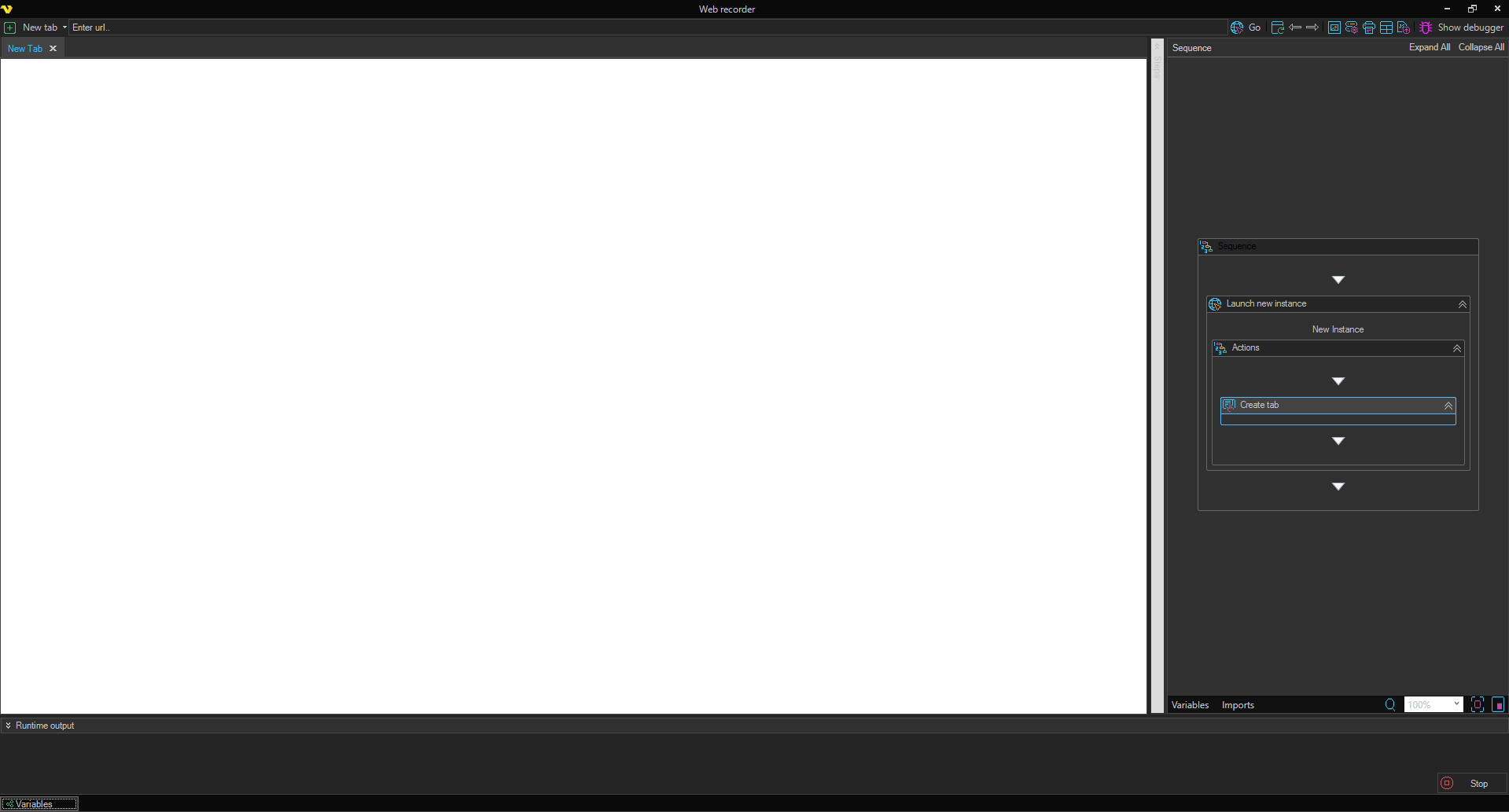
Creating actions
Actions are created automatically while you record. You can also add some actions manually, from the toolbar or by right-clicking an element in the browser.
Tabs
The Task handles several tabs. A tab opens automatically when a popup opens a new target window. To open a tab yourself, click New tab, then Normal mode or Incognito mode. In Incognito mode, no cookies are stored.
Right-click menu
You can right-click anywhere in the browser. Some items depend on the element you right-click, such as Add Download action and Add Extract Data action.

Troubleshooting
Recording works, but playback gives JavaScript errors
Check whether Disable WebSecurity is selected on the Web macro Main settings tab. It is selected by default. If it was cleared, select it again, but only for macros that visit sites you trust; see the warning in Web macro: Main settings tab.
Channel Disconnected
If this error appears, run the Client as administrator:
- Right-click "VisualCronClient.exe".
- Click Run as administrator.